
Memecoin trading means buying a token with no cash flow behind it, hoping its market cap rises, and selling before it falls. You find it on a launchpad or a trending list, check the contract, buy with a trading bot, and set exits in advance.
CoinGecko found that from April 2024 through late 2025 the majority of active Pump.fun wallets ended each month in the red, and that the share of profitable wallets rose in 2026. Either way, the loss is yours to size, so the routine below starts with checks and exits.
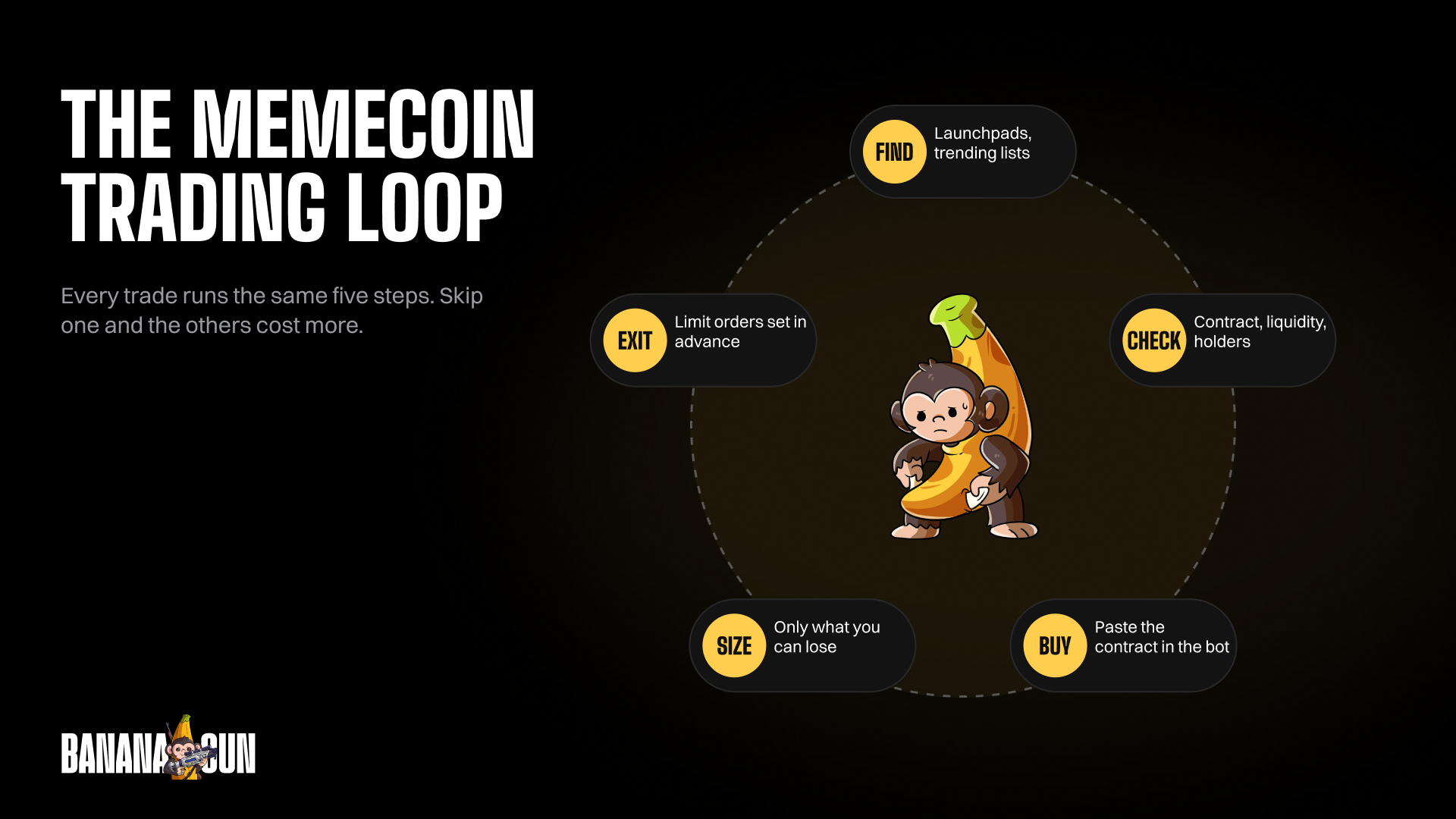
Where do meme coins launch?
On Solana, one common launch venue is Pump.fun, where a token trades on a bonding curve before it bonds to a DEX such as Raydium. CoinGecko's profitability study counts wallet activity across Pump.fun and PumpSwap.
Below is the Pump.fun board on 1 October 2026: a feed of trader callouts on the left and a Trending list on the right.
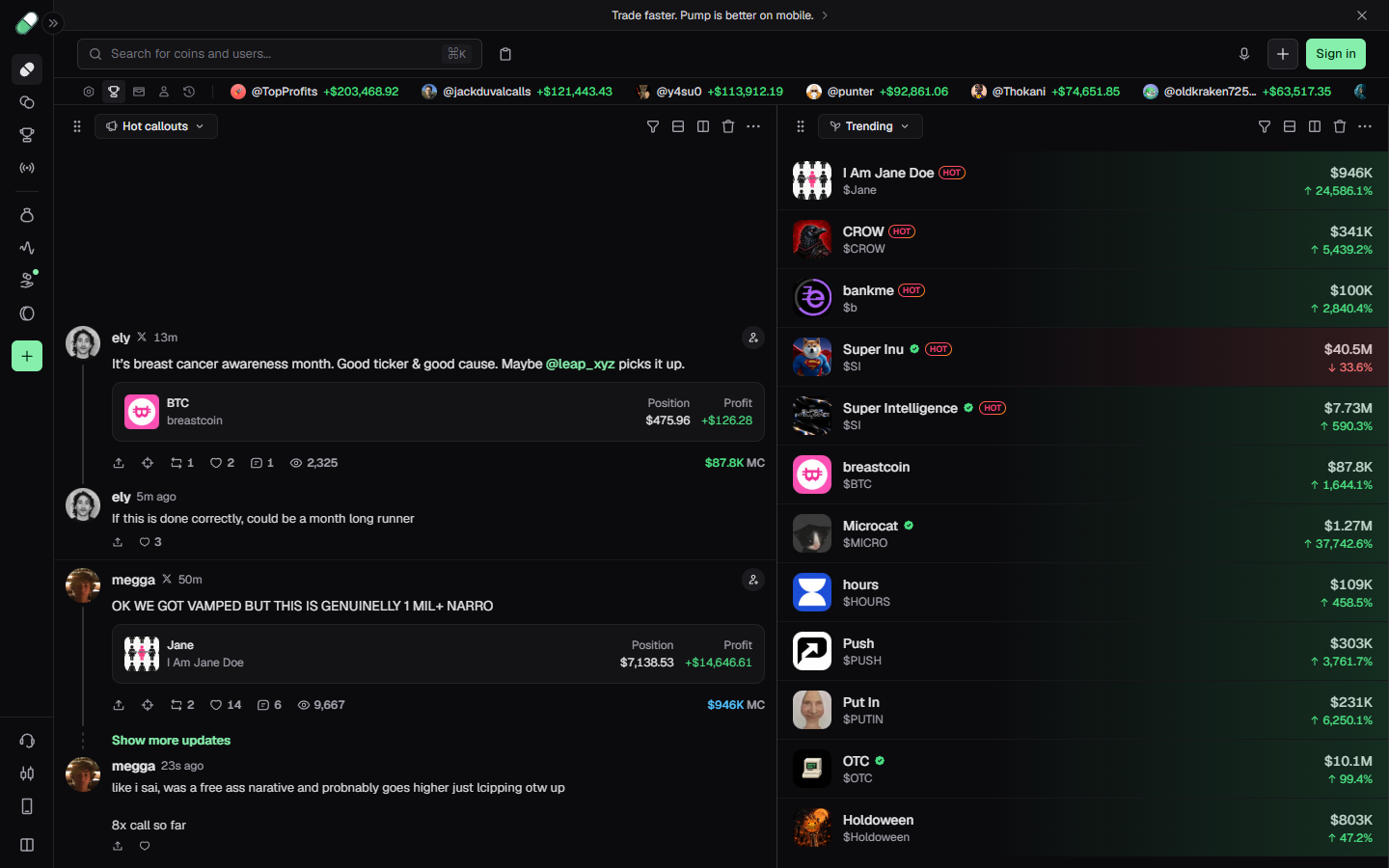
Pump.fun board on 1 October 2026 with a Hot callouts feed and a Trending list showing market cap and percent change
Other chains have their own launch zones. Banana Gun covers Ethereum, Solana, BNB Chain, Base, Robinhood Chain and others, so the routine below applies on any of them. For the launch mechanics, see what Pump.fun is and how a bonding curve launch works.
How do you find meme coins worth looking at?
Use a trending list for tokens that already trade, and a new-deploys list for tokens that just launched. They answer different questions.
Banana Gun Pro has both. Its Trending page has a chain selector, timeframes of 5M, 1H, 4H, 12H and 24H, and a Filter for maximum token age, minimum market cap, minimum liquidity and minimum volume. Each row shows holders, market cap with percent change, liquidity, volume, buys and sells, and fees.
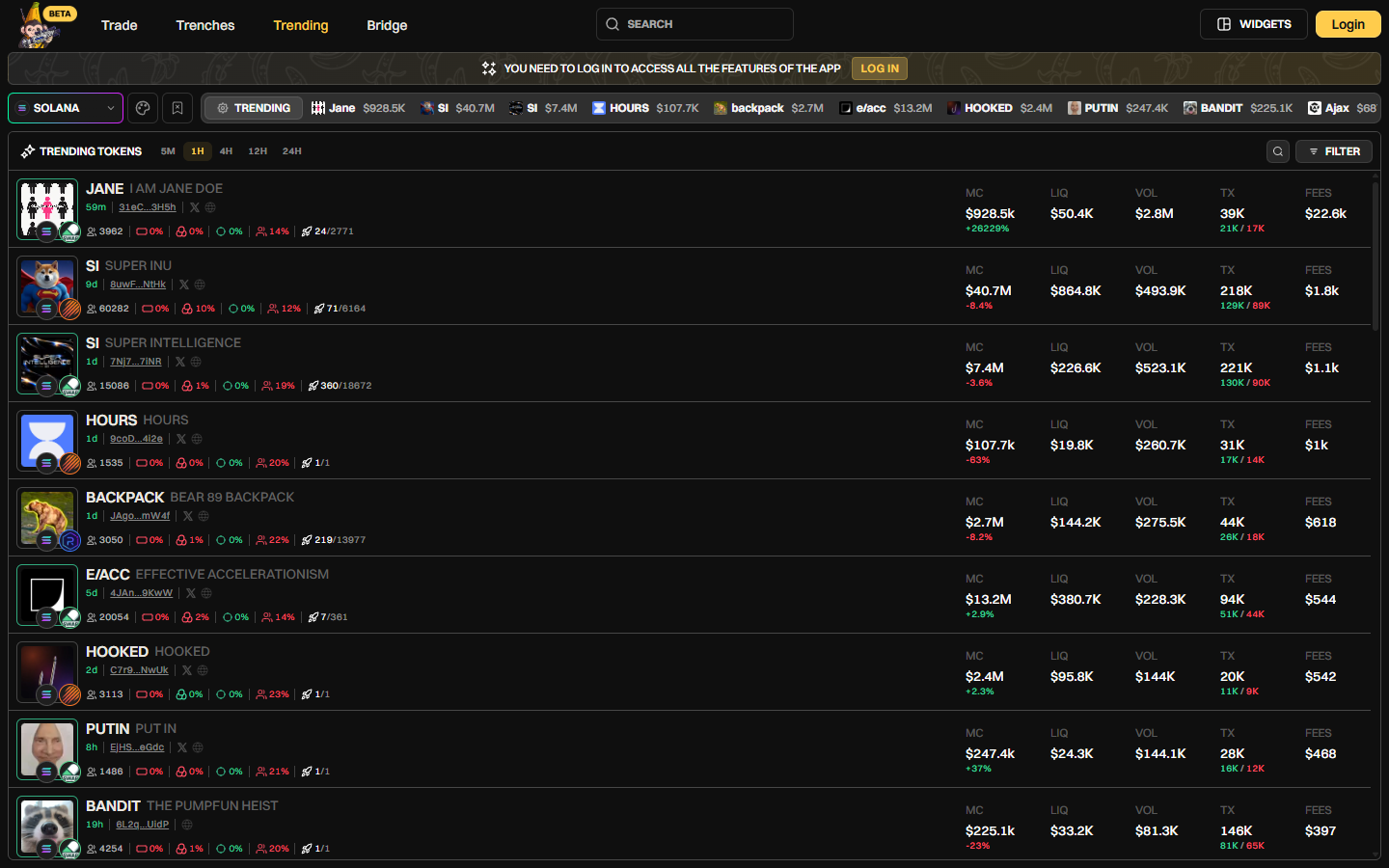
Banana Gun Pro Trending page on Solana, 1H timeframe, listing tokens by market cap, liquidity, volume and fees, 1 October 2026
Trenches lists NEW DEPLOYS with market cap, volume, transactions and age, plus "First 100 buyers status" and "Dev wallet funding" fields. A brand-new token has the least history to check.
The Trending page is public and in beta. Trenches is visible after login, and so is trading. The sign-in window offers Telegram, Google, Twitter or a wallet such as Phantom, MetaMask or Coinbase.
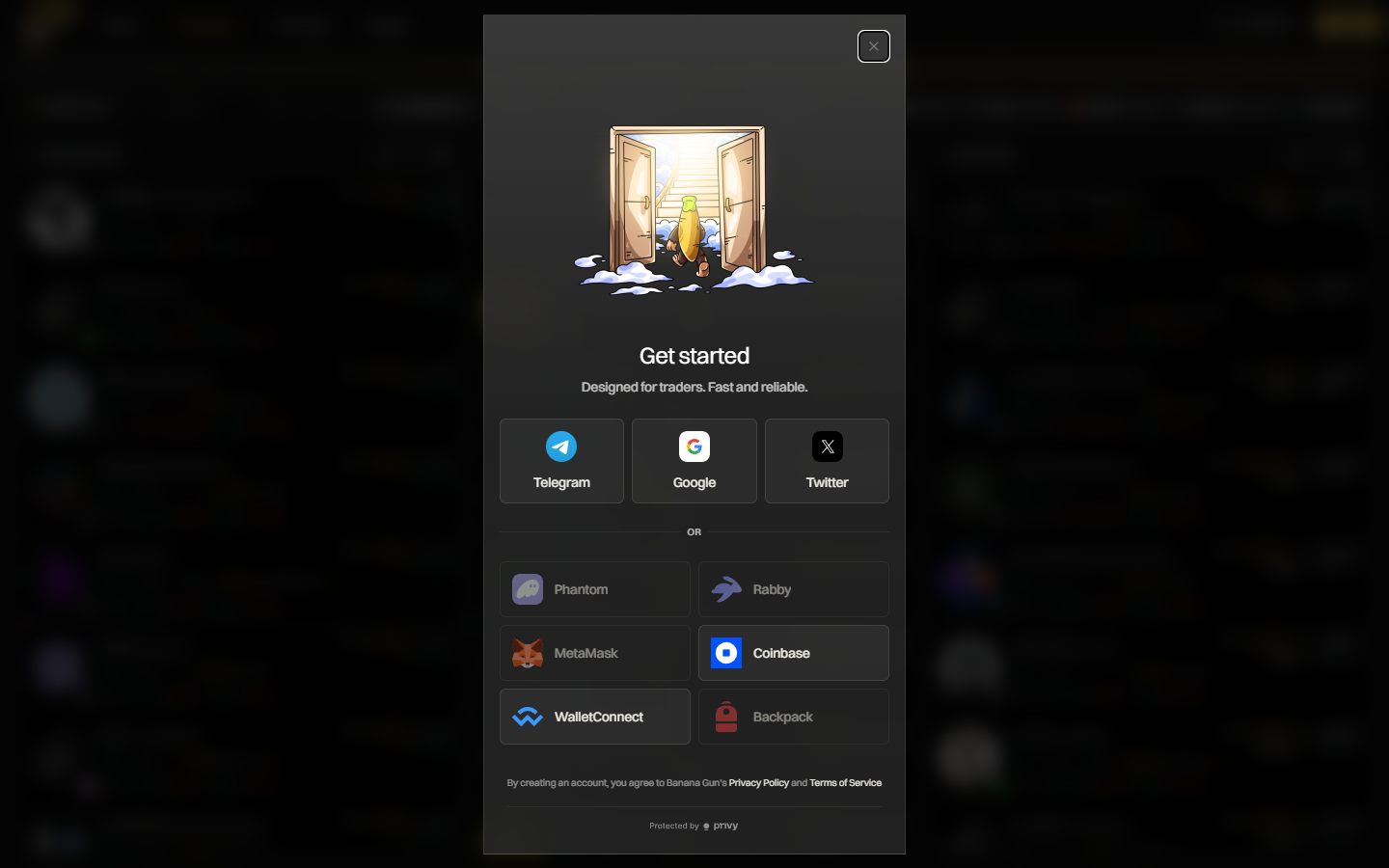
Banana Gun Pro sign-in window with Telegram, Google, Twitter and wallet options such as Phantom, MetaMask and Coinbase, 1 October 2026
A minimum liquidity filter is the one setting worth turning on first. A token with a large market cap and a tiny pool lets you in cheaply and charges you on the way out. The post on trending tokens on Solana covers the other discovery tools.
How do you check a meme coin before you buy?
Check the contract address first, then the supply, then the exits. These six checks cover it.
- The contract matches the address on the project's own channel. A ticker proves nothing, because copies reuse it.
- Mint authority is gone, or you accept that more supply can be created.
- Freeze authority is gone, or you accept that holder accounts can be frozen.
- Liquidity is burned or locked. Otherwise whoever holds the LP tokens can withdraw it.
- A few wallets do not hold most of the supply, since they can sell into every buyer.
- You can sell. A honeypot is a token you can buy but cannot sell.
Banana Gun runs a pre-trade sell check that blocks a buy when you cannot sell the token, before the buy goes through. That is a honeypot check, and a honeypot check is not a rug check. Anti-Rug has a documented 80 to 85 percent success rate on the scenarios it targets, which is not 100 percent.
On EVM chains a contract can also carry buy and sell taxes, max transaction limits and blacklist functions. Read how to read a token contract before you buy for each of those.
How do you buy a meme coin with Banana Gun?
The steps below use the Telegram bot on Solana.
1. Start and fund a wallet
Open t.me/BananaGun_bot, tap Start, then Wallet Setup and Create Wallet. The private key is shown once and cannot be shown again, so save it offline. Send at least 0.1 SOL to the address under /wallets.
2. Paste the contract
Paste the contract address or a Birdeye, DexScreener or pump.fun link. The buy menu lists Market Cap, Liquidity in SOL, Price and Tax at paste time.
3. Buy and confirm
Tap Buy with a preset or custom SOL amount, then wait for Buy Success. Check /positions afterwards. If the buy fails, raise buy gas, the MEV tip or slippage, one at a time. The full walk-through is in the first trade guide.
Menu names can shift between bot updates, so if a label reads slightly differently, look for the closest match in the same menu.
How do you size a position and exit?
Pick the loss you accept before you pick the amount. A meme coin can go to zero, so the size you buy is the size you can lose.
Fees count against every round trip. Banana Gun charges 1% on Solana and other chains besides Ethereum, and 0.5% on Ethereum manual buys and limit orders, according to docs.bananagun.io. On Solana that is 2% in and out before slippage.
Set exits as limit orders. Paste the contract, tap Setup Sell Limit Order, choose Take Profit or Stop Loss, and trigger on Market Cap or Token Price percent change. A +300% trigger is a 4x.
Example: a token at a $150K market cap needs $600K for a 4x. A token at $5M needs $20M, which is a far bigger ask of the market.
Trailing Stop Loss raises its trigger as price makes new highs. It protects a run, though slippage can still fill a sell below your trigger. A take profit that is never reached never sells, so a plan with only one distant target can leave you holding a token that has round-tripped to nothing.
Sell part of the position at a level you can reach, and let the rest follow a trailing stop.
Do meme coin traders actually make money?
Most did not, for most of the period measured, and the picture changed in 2026. All of the figures below come from Pump.fun wallets; none cover Robinhood Chain or other EVM chains.
CoinGecko Research, updated 7 May 2026, tracked monthly realized PnL on Pump.fun and PumpSwap. The share of profitable wallets was 47.58% in April 2024 and 30.08% in June 2025, when 3,651,622 of 5,222,847 wallets were in the red. By February 2026 it reached 56.83%, then 70.00% in March and 73.28% in April 2026 (CoinGecko Research).
Do not read April 2026 as easy money. In that month 65.1% of wallets made between $1 and $500, and 5.4% made over $1,000.
CoinGecko's own hypothesis is a natural exodus of unprofitable traders, since monthly active wallets fell from a peak of 5.2M in May 2025 to 1.8M in December 2025. It also warns that the study counts only realized PnL, so it excludes holders who never sold a token that crashed to zero. Bot and wash trading was not filtered out. CoinGecko's data ends on 30 April 2026.
Earlier studies point the same direction. BeInCrypto, on 5 June 2025, reported that of 4.257 million addresses that traded more than 10 Pump.fun tokens over six months, around 2.4 million (56.6%) posted cumulative losses between $0 and $1,000 (BeInCrypto). About 5,000 addresses made over $100,000.
Cointelegraph, on 10 January 2025, counted 55,296 of 13.55 million Pump.fun wallets with realized profits above $10,000 (Cointelegraph via TradingView). That counts wallets above a threshold and says nothing about the share that lost. Pump.fun's co-founder disputed it, saying the data omits coins bought after they moved to Raydium.
The data above does not show what profitable wallets do differently. The routine here covers what you control: checks before the buy, size, and exits set in advance.
Frequently asked questions
Can you make money trading meme coins?
Some wallets do. In CoinGecko's data 73.28% of Pump.fun traders were profitable in April 2026, but in June 2025 only 30.08% were. In April 2026, 65.1% of wallets made $1 to $500, and the study counts realized PnL only.
What is the best way to find meme coins to trade?
Combine a trending list with filters and a new-deploys list. Banana Gun Pro has both, in Trending and Trenches. Trending is public; Trenches is visible after login. Then check the contract before you buy.
How much should you put into one meme coin?
Only an amount you can lose completely. Fees of 1% each way on Solana mean a token has to rise a little over 2% before you break even, and slippage adds to that. Size around the loss you accept, not the gain you hope for.
Is a honeypot the same as a rug pull?
No. A honeypot is a token you can buy but cannot sell. A rug pull is liquidity or supply being pulled out from under holders. Banana Gun's sell check covers the first, and Anti-Rug targets some of the second.
Can you trade meme coins on more than one chain?
Yes. Banana Gun lists Ethereum, Solana, BNB Chain, Base, Robinhood Chain and others, and the bot and Banana Gun Pro cover the same chains. Gas and the launch venue differ by chain.
Open Banana Gun on Telegram or the Banana Gun Pro terminal and start with the check, not the buy.