
The token contract is the most honest document a project produces. It cannot be edited after deployment, it cannot be taken down, and it does not rely on the team's word. Every rule governing how a token works, who can call which functions, and what happens to your money is encoded there in plain logic.
Most traders never look at it. That gap is why rug pulls, honeypots, and hidden-fee tokens keep finding victims. This guide walks through the key fields in a standard ERC-20 or BEP-20 contract, what each one means, and what should raise a flag.
What Is a Token Contract?
A token contract is a piece of code deployed on a blockchain that defines the rules for a cryptocurrency token. It specifies the total supply, how tokens are transferred between wallets, who holds special permissions, and what conditions can trigger unusual behavior like minting new tokens or blocking sales.
On Ethereum, these are written in Solidity and follow the ERC-20 standard. On BNB Chain, the BEP-20 standard is functionally identical. The contract is published to the blockchain at a specific address, and once deployed, its core code cannot be changed unless the contract was deliberately designed to be upgradeable.
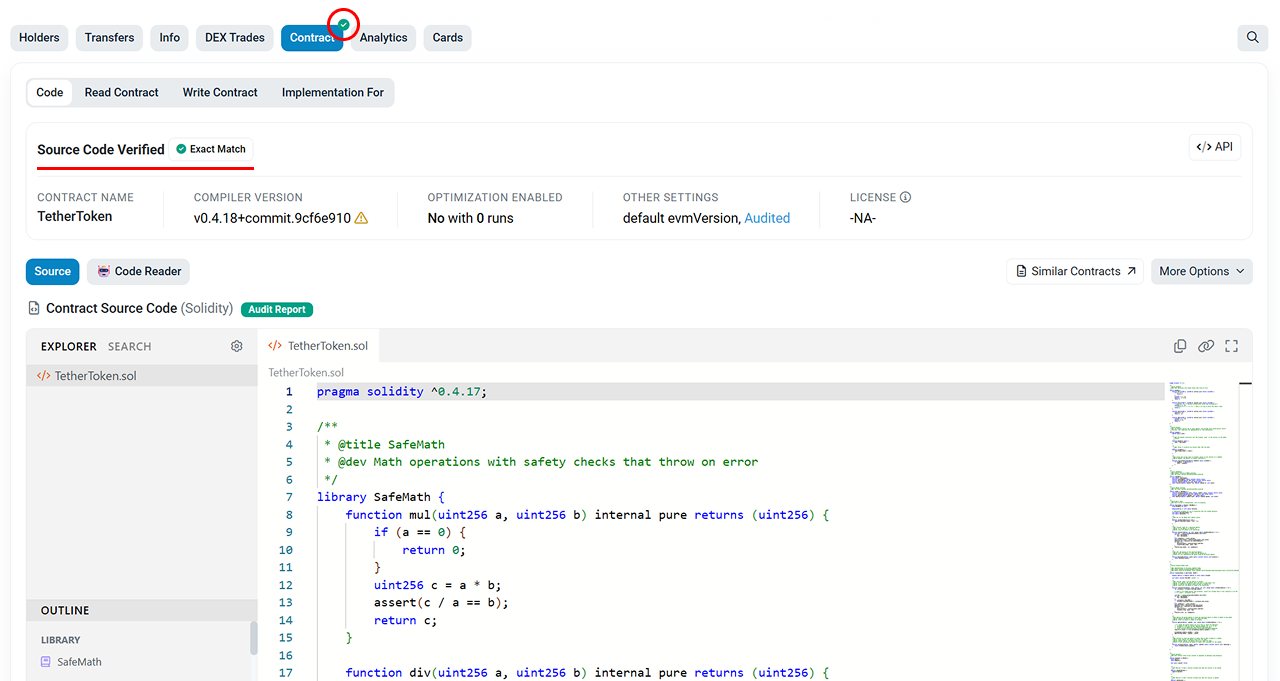
You read a contract by looking it up on a block explorer. For Ethereum tokens, that means Etherscan. For BNB Chain, BscScan. Search the contract address, click on the Contract tab, and if the developer verified the source code, you can read it in full. If the code is not verified, that is itself a warning sign.
Where Do You Find a Token's Contract Address?
The contract address is usually published in the project's official Telegram or Twitter. You can also find it by looking up the token name on a DEX aggregator like DexTools or DexScreener, which will display the contract address alongside the liquidity pool data.
Always copy the contract address from a verified official source, then cross-check it on the block explorer. Scammers frequently create near-identical token names with different contract addresses to trap people who search by name rather than address.
What Are the Key Fields to Check in a Token Contract?
Once you have the contract open on a block explorer, focus on these five areas.
Total supply and decimals: totalSupply() tells you how many tokens exist. The decimals field (usually 18) tells you how to read that number. A supply of 1,000,000,000,000 with 18 decimals means only 1,000,000 whole tokens. Check this against what the project claims in its materials.
Owner address: owner() returns the wallet controlling privileged functions. An active wallet address means the deployer still holds control. The zero address (0x0000...0000) means ownership was renounced and no one can call owner-only functions.
Transfer restrictions: Look inside transfer() or transferFrom() for any logic that checks an address against a list before allowing the transaction. Whitelists restrict selling to approved addresses; blacklists block specific wallets. Either pattern can trap your tokens permanently.
Fee functions: Search for any function reading or writing a fee, tax, or commission value. Note both the current value and whether the owner can change it. A setFee() callable by the owner with no cap is a structural risk even if the current rate is low.
Mint function: A callable mint() means the supply is not fixed. The deployer can create tokens at will and sell them into the liquidity pool, diluting every holder.
What Does 'Verified Contract' Mean on Etherscan?
A verified contract on Etherscan means the developer submitted the original Solidity source code and the compiler confirmed it matches the deployed bytecode. This lets you read it in human-readable form. An unverified contract is a practical stop sign for retail traders: you cannot audit what you cannot read, and if the team will not verify their code, that choice tells you something.
How to Spot Hidden Functions That Could Harm You
Not every dangerous function has an obvious name. Common patterns include an enableTrading() that also embeds a hidden sell-block, or an antiBot() that blacklists any wallet selling above a threshold. Search for any function that modifies a mapping (a list linking addresses to values). If the owner can add addresses to a mapping that is checked inside transfer(), that mapping is likely a blacklist.
Hidden fees matter most for slippage. A 5% transfer tax plus a variable owner fee means you need both values in your tolerance calculation. Our guide on what is slippage in crypto and how to set it correctly explains exactly how to account for token taxes before you submit.
How Banana Pro's Real-Time Scanner Does This Automatically
The checks described above cover the manual process. Banana Pro runs them automatically on any token you look up, in real time, without requiring you to open a block explorer or read any code. The scanner checks for mint authority, ownership status, transfer restrictions, fee functions, and honeypot patterns as you browse.
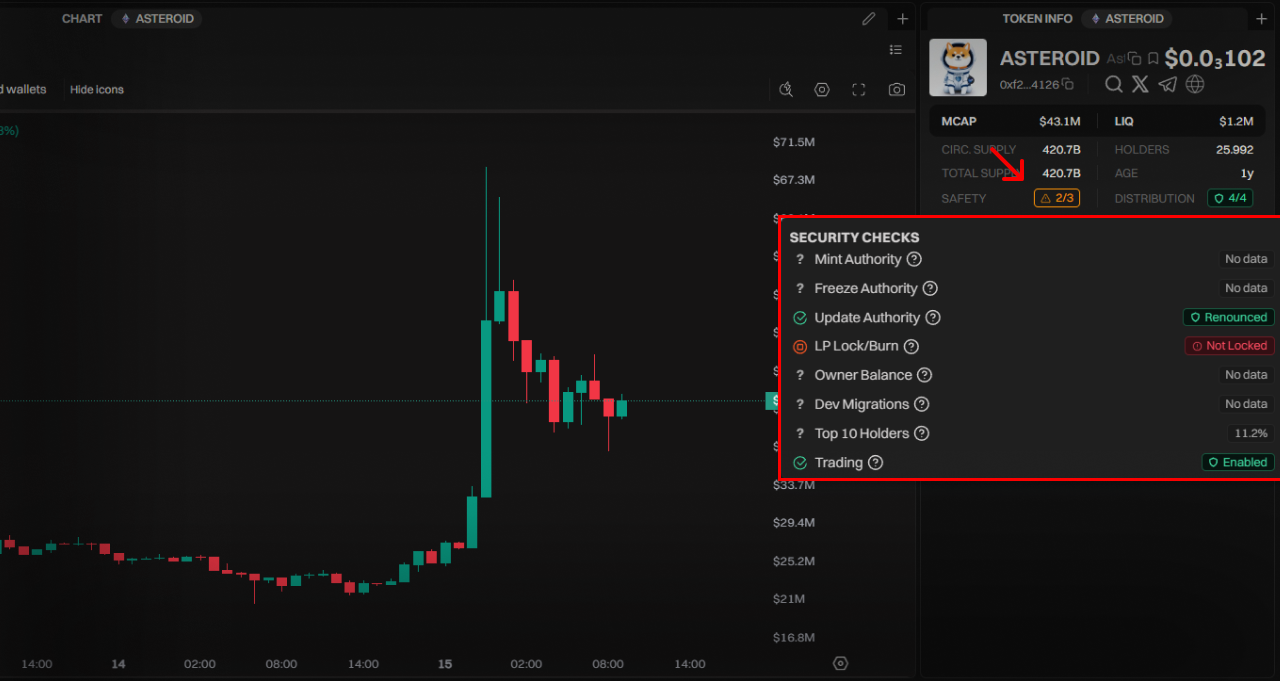
The critical advantage over static tools is that Banana Pro scans for contract changes in real time. Some contracts are deployed clean and then upgraded later to add malicious functions, often through a proxy contract pattern. A scan done at launch would pass; a scan done after the upgrade would flag it. Banana Pro's continuous monitoring catches this scenario.
For wallets that were already flagged in the context of rug pulls, the overlap with Banana Pro's security layer is direct. The seven contract-level patterns detailed in our article on rug pull warning signs in a token contract are the same patterns the scanner checks against.
If you prefer Telegram-based trading, Banana Gun's bot integrates these security checks alongside sniping, limit orders, and DCA execution on supported chains.
What Does a Structurally Sound Contract Look Like?
No checklist guarantees a successful project, but a contract that passes these criteria is structurally honest: ownership renounced (zero address as owner); no callable mint function post-deployment; transfer function with no address-based restrictions; fees either absent or hard-coded with no owner override; source code verified on the block explorer; liquidity locked in a third-party locker for a meaningful duration. Meeting all of these means the developers cannot easily manipulate the mechanics against you. Team quality and product execution are separate questions the contract cannot answer.
Frequently Asked Questions
Do I need to know how to code to read a token contract?
Not for the basics. Owner address, total supply, transfer restrictions, and fee functions are readable in plain English once the source code is verified on a block explorer. Automated scanners reduce the barrier further for traders who want a faster check.
What is a proxy contract and why does it matter for safety?
A proxy contract separates the token's logic from its storage, allowing the logic to be upgraded after deployment. If a contract is upgradeable, any audit or scan done before an upgrade is potentially obsolete. Check for a delegatecall pattern or an explicit upgrade function before trusting the verified code as final.
What is the difference between a token and a coin?
A coin is the native currency of a blockchain, such as ETH or BNB. A token is deployed as a smart contract on top of an existing chain. When reading contract code before a trade, you are almost always looking at a token, not a coin.
Can a contract be changed after it is deployed?
A non-upgradeable contract cannot have its core logic changed after deployment. Contracts with a proxy pattern, or where the owner retains control over fee and restriction parameters, can be functionally modified post-launch. That is why owner permissions matter as much as the initial code.