
The Newest Heavy Hitter Goes Live
On July 1, 2026, Robinhood quietly flipped the switch on something that turned out to be anything but quiet. Robinhood Chain, a dedicated Layer 2 built specifically for tokenized real-world assets, went live. Within hours, the numbers started doing things that made even experienced traders do a double-take.
The pitch was straightforward: a purpose-built chain for tokenized stocks, stablecoins, and eventually a broader universe of real-world assets (RWAs), all sitting on top of Arbitrum's infrastructure. Think of it as Wall Street getting a DeFi makeover, minus the suits and the 9-to-5 schedule.
In its first week alone, the chain pulled in ~$3.1B in DEX volume, immediately slotting into the top 5 chains globally by that metric, a feat that took most L2s months or even years to achieve. Analysts at Bernstein flagged the milestone almost immediately, noting the chain's rapid ascent into elite DEX volume territory. Alongside that volume, 65,000 users showed up to the party, bringing $13M in tokenized stocks and $300M in stablecoins with them.
The architecture choice is Arbitrum as the base layer. With 200M+ transactions already processed on testnet before launch day, Robinhood Chain arrived with receipts. The infrastructure was stress-tested before the doors opened. That's not luck; that's planning.
"Robinhood Chain has surpassed 100 million cumulative transactions in just three weeks." — Arbitrum, via official announcement (July 23, 2026)
For a chain that technically didn't exist two months ago, that hits different.

From $10M Days to $800M Days
Daily DEX volume on Robinhood Chain went from roughly $10M to $800M in just two weeks. Let that math sink in. That's an 80x increase in daily trading activity in fourteen days. By the time cumulative volume crossed $9B around July 21, the DeFi analytics community had fully woken up to the fact that something unusual was happening.
By late July, daily DEX volume had settled into a still-impressive ~$479M range, with 6.5 million daily transactions and 246,000 daily active addresses keeping the network humming. The chain had also crossed 100 million cumulative transactions in its first three weeks.
On the revenue side, $2M in cumulative revenue had been generated for the chain, including $200K in AEP (Arbitrum Ecosystem Program) fees earmarked to support long-term ecosystem development. It's not a jaw-dropping treasury number yet, but for a chain barely four weeks old, it's a solid foundation and a proof-of-concept for the fee model.
For snipers and high-frequency traders, the volume ramp created real opportunity. Early-stage chains with surging liquidity and thin order books are a natural hunting ground. Copy-trade flows and MEV-adjacent strategies found fertile ground in the chain's early weeks, as new token pairs spun up faster than most could track.
DefiLlama data confirmed the chain's strong TVL and fee metrics, cementing its place not just as a hype story but as a genuinely active network.
The Memecoin Phase, Then the RWA Glow-Up
Robinhood built a chain for tokenized stocks. The market responded by... trading memecoins on it. A lot of memecoins. As CoinDesk noted in a mid-July report, memecoins initially dominated trading activity on a chain that was explicitly designed as infrastructure for real-world financial assets. The tokenized stocks were there. The stablecoins were there. But the degens? They found the meme tokens first. Priorities.
This is, of course, extremely on-brand for crypto. You can build the most serious, institutionally-minded financial infrastructure imaginable, and within 48 hours, someone will launch a dog coin on it and it'll out-volume your blue-chip assets.
But here's the pivot that matters: by July 25, real-world asset activity on the chain had jumped 5x. The memecoin phase appears to have been less a derailment and more a warm-up lap. As the chain matured, tokenized stocks stepped into the spotlight. With approximately 12 tokenized stocks now each clearing around $500K in daily volume, the RWA thesis Robinhood built the chain around is starting to validate in real numbers.
The RWA surge also has broader implications. Tokenization of physical assets is a multi-trillion-dollar opportunity, and a chain with proven volume throughput and an existing user base has a real shot at becoming a liquidity hub for that market.
Robinhood's CEO Hack: What happened?
No major crypto launch is apparently complete without at least one chaotic subplot, and Robinhood Chain delivered on that front too.
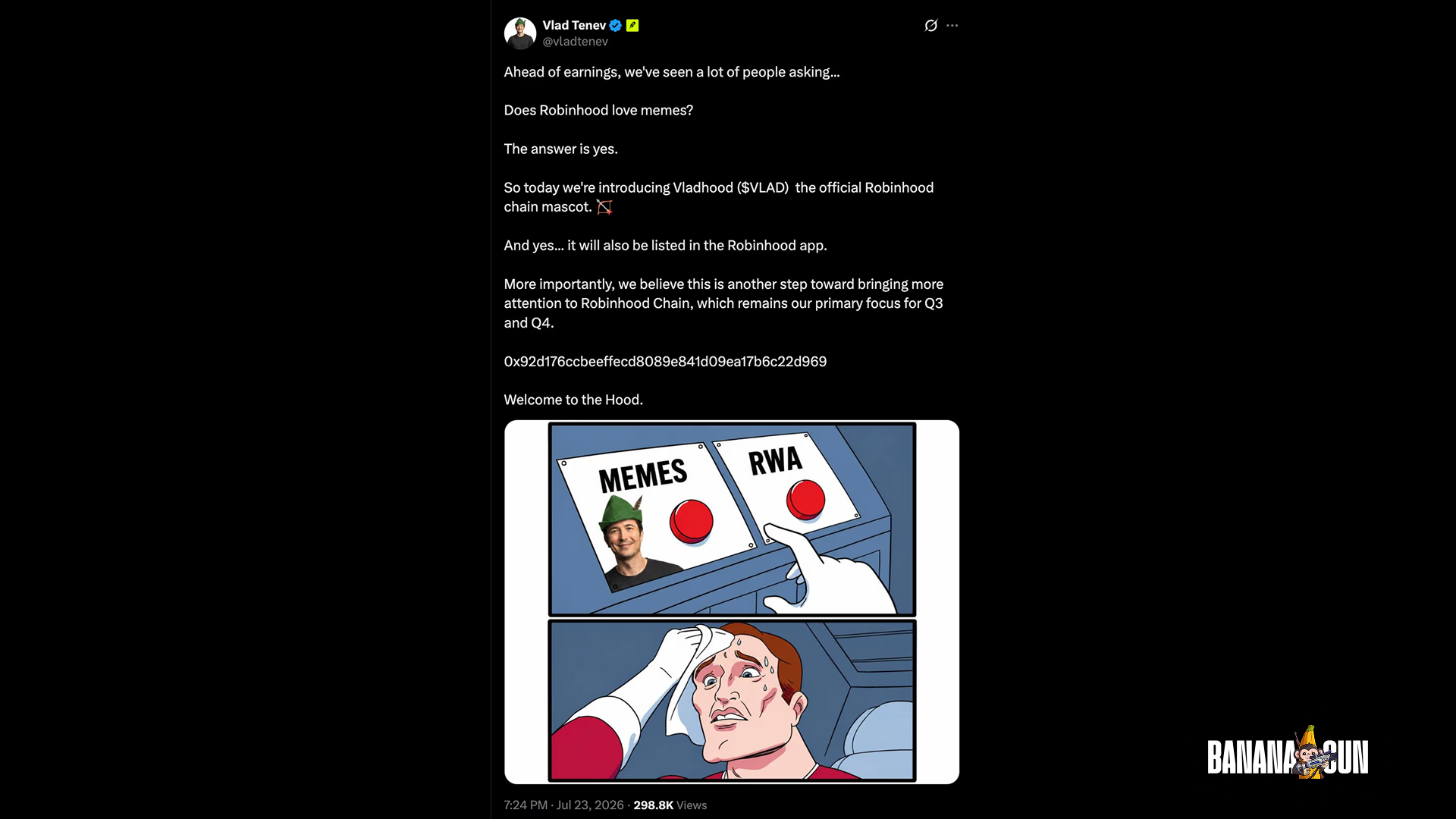
During the chain's early weeks, Robinhood CEO Vlad Tenev's X (formerly Twitter) account was compromised. The attackers, following the well-worn playbook of crypto social engineering hacks, used the account to promote a token, attempting to leverage Tenev's profile and the surrounding Robinhood Chain hype to pump a fraudulent asset.
It's a grim reminder that in crypto, the bigger the launch, the bigger the target. High-profile account hacks tied to token promotions have become an almost predictable feature of any major chain or project announcement — bad actors watch the news cycle and move fast.