


What DexScreener does
A decentralised exchange does not have a central order book to read. Each pair is a pool of two assets, and the price comes out of the ratio between them.
DexScreener indexes those pools and renders them as charts you can read like any other market. It covers many chains at once, which is why it became the default place people look when a token gets mentioned somewhere.
The part that keeps traders on it is the new pairs feed, filtered by chain, liquidity and age. That feed is a discovery tool rather than a recommendation engine.
Which numbers are expensive to fake, and which are not
This is the whole skill. Everything on a pair page can be influenced, and the cost of influencing it varies enormously.

The volume to liquidity ratio, and why it matters
Divide daily volume by pool liquidity. A pool with real interest usually turns over some sensible multiple of itself in a day.
When that ratio gets absurd, something other than organic demand is producing the trades. Wash trading between related wallets generates volume and produces no buyer who might sell back to you later.
There is no universal threshold worth quoting, and any specific number would be invented. What works is comparing a pair against other pairs of similar size on the same chain, which is a judgement you build by looking at many of them.
Promotion on the page is not a quality signal
Trending placement and paid promotion exist on tools like this, and paying for visibility is available to anyone with a budget.
A promoted token has demonstrated willingness to spend on attention. That is genuinely information, and it is information about marketing rather than about the asset.


The new pairs feed, and how to filter it
Unfiltered, a new pairs feed is unusable. Hundreds of pools appear per hour on an active chain and almost none of them matter.
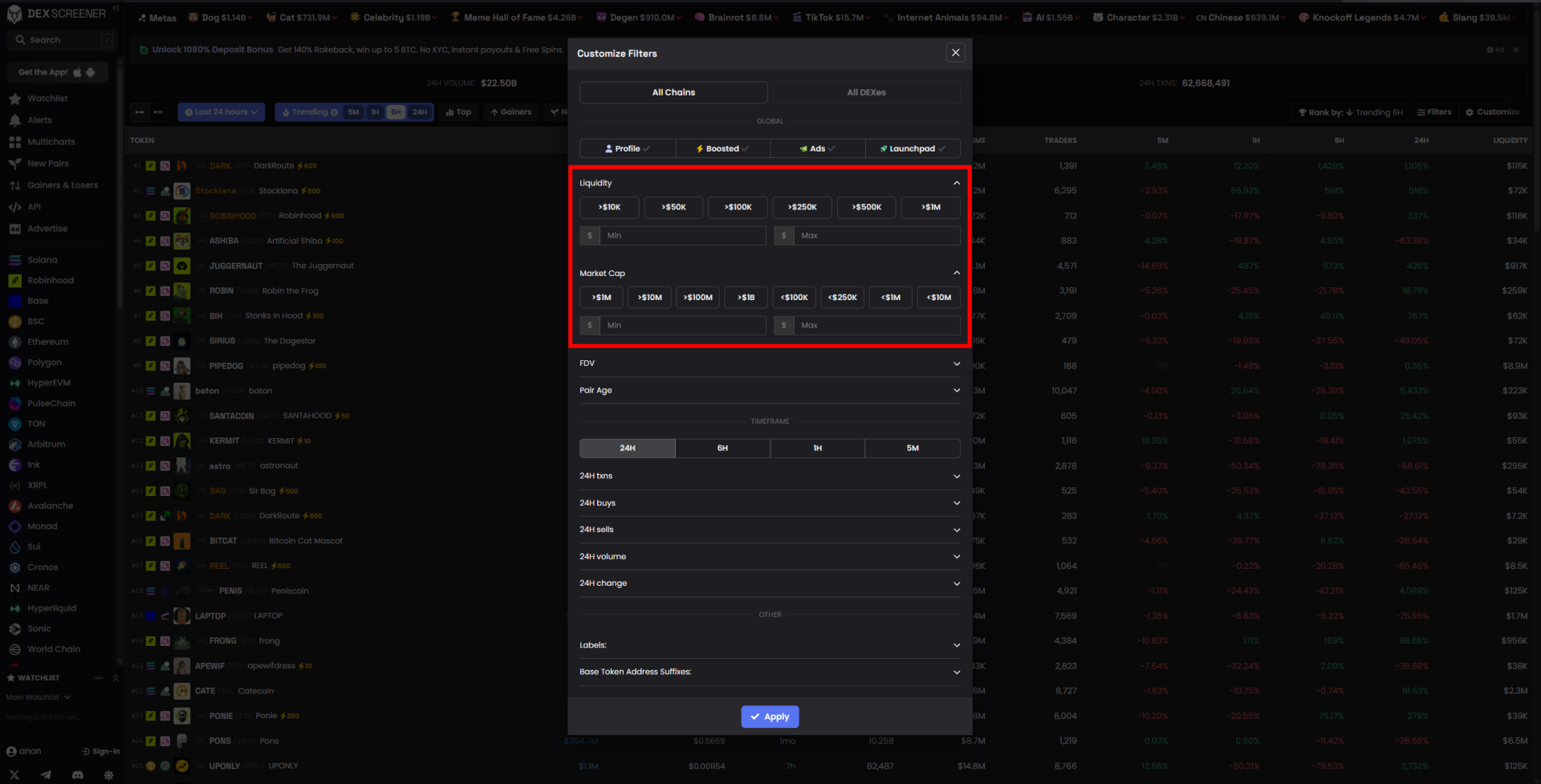
The filters that make it readable are minimum liquidity, minimum pool age and a chain restriction. Liquidity screens out pools too small to trade, age screens out the first chaotic minutes, and the chain filter keeps you where your funds already are.
Any specific threshold you set is a preference rather than a rule. What matters is that you set one deliberately, because the default view is designed to show everything rather than to show what is worth your attention.
What DexScreener cannot see
- Whether mint authority is revoked, so whether supply is actually fixed.
- Whether freeze authority is live, so whether you will be able to sell.
- Whether the top holders are twenty wallets funded from one source.
- Whether liquidity is locked, or simply present at the moment you looked.
Those live on an explorer or a risk scanner. The workflow that survives contact with a real market is chart first, configuration second, and execution third.
Closing the gap between finding and buying
Discovery tools create a specific problem. You find something on a feed of pairs minutes old, and then you have to get from a chart to a filled order while the reason you were interested is still true.
Copying the contract address into Telegram and trading there is one answer, which is the shape Banana Gun takes. Working from a full terminal where the chart and the order live together is the other, which is Banana Pro.
The check does not get skipped either way. It gets done and then acted on quickly, which is a different thing from being done carelessly.