

Polymarket is legal to use in the United States again. It returned through a CFTC-regulated exchange structure it built in 2025, though the state-level picture underneath that federal approval is far from settled. If you trade on Polymarket, or you compare it to a terminal like Banana Predict, your state matters. Several states are actively suing to block sports-related contracts, while most states have taken no action at all.
Below is the 2022 settlement history, the 2025 to 2026 US return, the state-by-state legal fight, and the California nuance, pulled from regulators and reputable reporting.
This article is general information, not legal advice. Prediction market regulation is moving fast in 2026 and rules can change quickly. Confirm current eligibility directly with Polymarket before you trade.
Is Polymarket Legal in the US? The Short Answer
Yes, at the federal level. The Commodity Futures Trading Commission approved Polymarket's return to the US in September 2025, after the company acquired a CFTC-licensed derivatives exchange. Reuters reported the approval came more than three years after Polymarket agreed to block American users.
That federal green light does not settle things everywhere. Nevada, Massachusetts, and a handful of other states argue their own gambling laws still apply to sports-related contracts, and that fight is playing out in court right now.
The National Conference of State Legislatures counted more than 20 lawsuits and cease-and-desist actions pending nationwide as of early 2026. A small group of states is pushing back hard. Most states have not moved at all.
So the honest answer depends on where you live and what you are trading. Federal law says yes. A handful of state regulators say not for sports contracts, and that fight is still unresolved.
Polymarket's 2022 CFTC Settlement, Explained
In January 2022, the CFTC ordered Blockratize, Inc., doing business as Polymarket, to pay a $1.4 million civil penalty. The charge: offering event-based binary options without registering as a designated contract market or swap execution facility.
Event-based binary options are yes-or-no contracts that pay out based on whether a real-world event happens, the same structure behind most prediction market trades.
A designated contract market and a swap execution facility are the two CFTC-licensed structures built to trade that kind of contract legally in the US.
The order also required Polymarket to wind down its noncompliant markets. Polymarket complied by geofencing US IP addresses and blocking American accounts, a step Yahoo Finance covered at the time. From 2022 through most of 2025, US residents were locked out entirely.
Polymarket did not appeal that penalty or fight the order in court. It spent the next three years building toward a different fix: owning one of those licensed structures outright.

How Polymarket Came Back to the US in 2025 and 2026
Polymarket's path back ran through acquisition rather than appeal. In July 2025 it bought QCX LLC and QC Clearing LLC, a CFTC-licensed derivatives exchange and clearinghouse known together as QCEX, for $112 million.
Owning a licensed exchange gave Polymarket a registered structure to operate inside, instead of around. The CFTC approved the relaunch that September and issued further sign-offs through the rest of 2025, clearing the way for a phased US rollout that continued into 2026.
Reuters tied the relaunch to both the QCEX purchase and a CFTC no-action letter, giving Polymarket two separate layers of federal cover rather than one. That combination is why the September 2025 approval stuck instead of facing another challenge.
Polymarket now operates in the US as a CFTC-regulated exchange, not the offshore platform it was before 2022. That shift is why the conversation moved from "is Polymarket banned" to "which states are trying to block it anyway."
Is Polymarket Legal in the US Right Now? The State Fight
Federal approval and state law are colliding. CFTC chair Michael Selig has said publicly that event contracts on a CFTC-registered exchange fall under exclusive federal jurisdiction, and that states cannot re-label them as illegal gambling.
NBC News quoted Selig calling state enforcement efforts "a power grab," in the context of Nevada's case against Kalshi.
A separate Holland & Knight legal alert ties Crypto.com to that same Nevada dispute, though the case Selig addressed directly named only Kalshi.
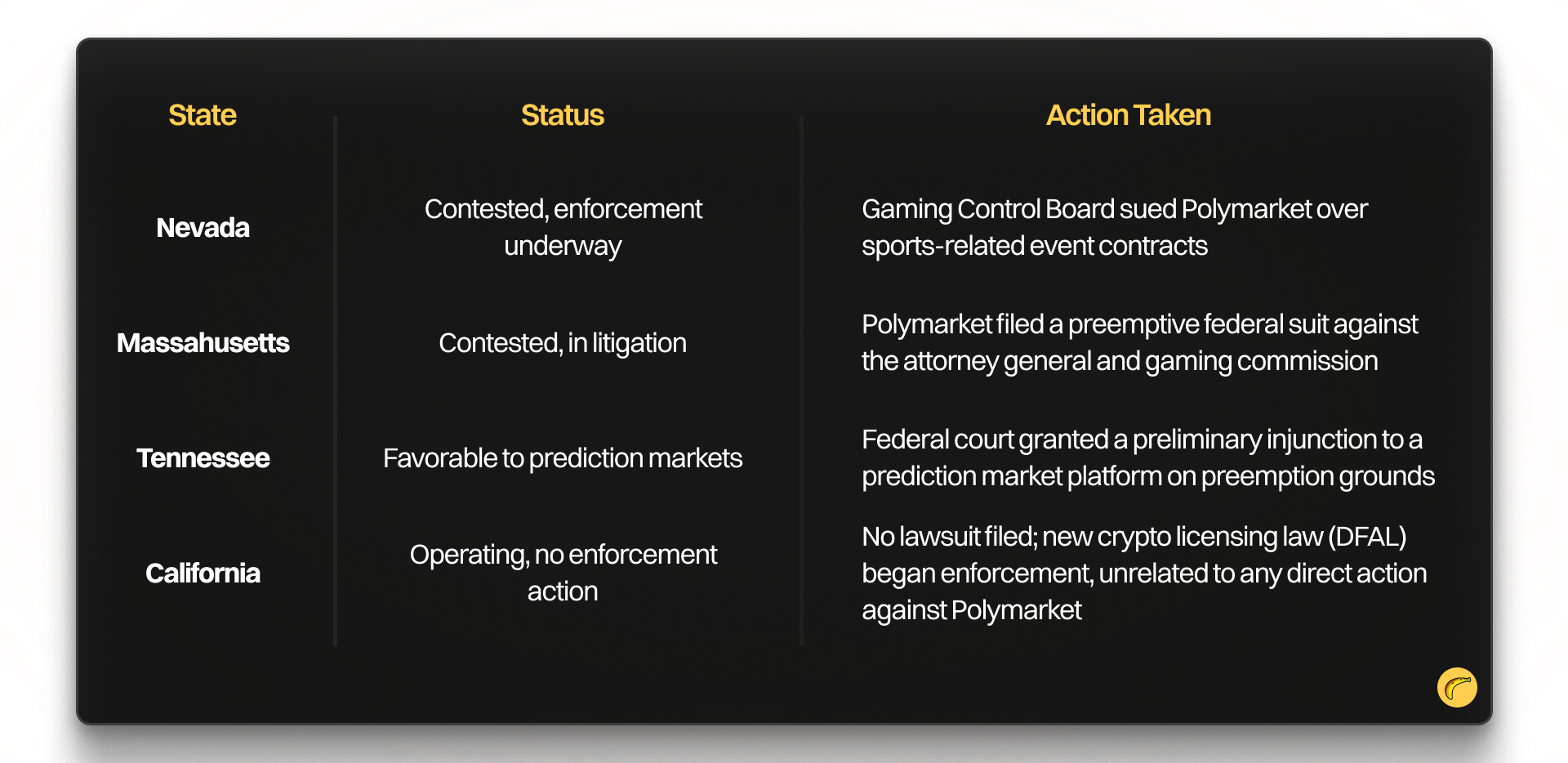
State gaming regulators see it differently. Nevada's Gaming Control Board treats sports-related event contracts as unlicensed sports betting under state law and has pursued enforcement against Polymarket directly, according to trade press reporting from January 2026.
Massachusetts went the other way. Polymarket sued the state first, asking a federal court to block a shutdown before it happened, naming the attorney general and gaming commission officials, per local reporting on the case.
The same Holland & Knight alert tracked rulings going both directions in the same week. A Tennessee federal court sided with a prediction market platform on preemption grounds, days after a Nevada court had leaned the other way.
So there is no single answer to "is Polymarket legal in the US." There is a federal framework that says yes, a small group of states actively litigating to say no for sports contracts, and most states doing neither.
Here is how four closely watched states compare right now.
Is Polymarket Legal in California?
As of mid-2026, Polymarket has been operating and accessible to eligible users in California, according to state-by-state tracking published by CBS Sports. California has not filed the kind of enforcement action Nevada has brought.
There is a wrinkle worth watching. California began enforcing its Digital Financial Assets Law on July 1, 2026, a licensing framework built for crypto businesses generally.
CBS Sports flags that law as something that could eventually touch prediction market platforms. No regulator or legal analysis has confirmed that it actually applies to Polymarket's California operations.
Treat "legal in California" as accurate for now, and subject to change, rather than a permanent status.
Where Is Polymarket Legal?
Most of the country, for most market categories, right now. The friction concentrates almost entirely on sports-related event contracts, the category state gaming regulators treat as a direct analog to sports betting.
Political, economic, and pop-culture markets, the kind that built Polymarket's reputation during election cycles, have drawn far less state-level legal challenge than sports contracts have. That split matters more than any single state's headline status.
The Same Markets, a Faster Terminal: Banana Predict
Banana Predict is not a rival inside the world of prediction markets. It is a terminal, that surfaces the same Polymarket markets and the same underlying liquidity through a faster interface built for active traders.
That distinction is worth making clearly. A different front end does not mean a different market. The odds, order books, and liquidity you see on Polymarket's own site are the same ones reflected in the Polymarket leaderboard and inside Banana Predict.
Banana Predict layers tools on top of that shared liquidity: portfolio tracking, a leaderboard, copytrade, and wallet and social tracking, across a broad range of market categories. A connected wallet is required to trade on Banana Predict.
Choosing the best prediction market app for you often comes down to which of those tools you want layered on top of the same underlying markets.
One clarification before you go further: this article covers Polymarket's own legal status, not Banana Predict's. Banana Predict's state-by-state availability has not been separately confirmed, so verify your own eligibility with either platform directly before you trade.