


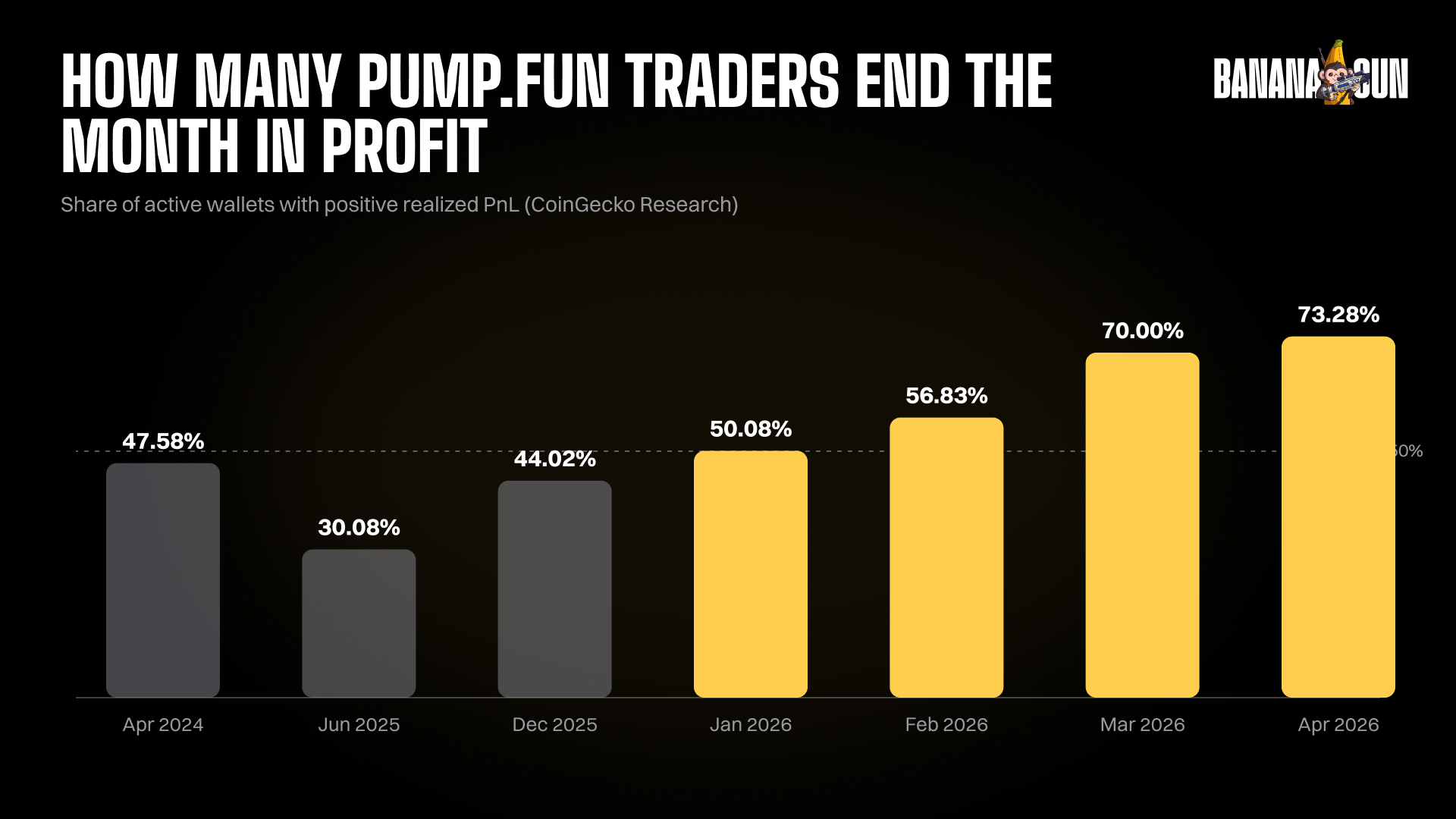
Yes, some traders do, but CoinGecko Research found that from April 2024 through late 2025 the majority of active Pump.fun traders walked away from each month in the red on realized PnL. That flipped in 2026: 73.28% of wallets had positive realized PnL in April 2026.
You are about to risk money on a token, so the useful question is what these figures count and what they leave out. This page walks through three published datasets, each with its date and its limits.
Every number here is about Pump.fun, which is Solana. We found no comparable study for Robinhood Chain or other EVM meme coins.
What does the data say about how many Pump.fun traders are profitable?
CoinGecko Research's study "Pump.fun Traders Are Making a Comeback" (updated 7 May 2026, author Loke Choon Khei) uses Dune data on Pump.fun and PumpSwap wallets. It tracks the share of wallets with positive realized PnL in each month.
CoinGecko's own summary: from April 2024 through late 2025 the majority of active traders walked away from each month in the red, with the share of profitable wallets "rarely exceeding 50% and bottoming out at just 30.1% in June 2025."

In June 2025, 3,651,622 of 5,222,847 wallets finished the month with a realized loss. In April 2026, 2,303,007 of 3,142,559 wallets finished with a realized gain.
Read the column as a snapshot of one month at a time. A wallet can be profitable in March and in the red in April, and the table does not follow the same wallet through time.
Why did the profitable share jump in 2026?
CoinGecko does not claim to know. Its authors write that they "hypothesize it reflects a natural exodus of unprofitable traders."
The activity numbers fit that idea. Monthly active wallets fell from a peak of 5.2M in May 2025 to 1.8M in December 2025, so the pool that remained was smaller and may have been better.
A hypothesis is not a result, and the study does not test it.
The data ends on 30 April 2026. We did not find newer figures for May through September 2026, so what happened since is not covered here.
How much do the profitable wallets actually make?
Most profits are small. CoinGecko broke April 2026 into profit and loss tiers.
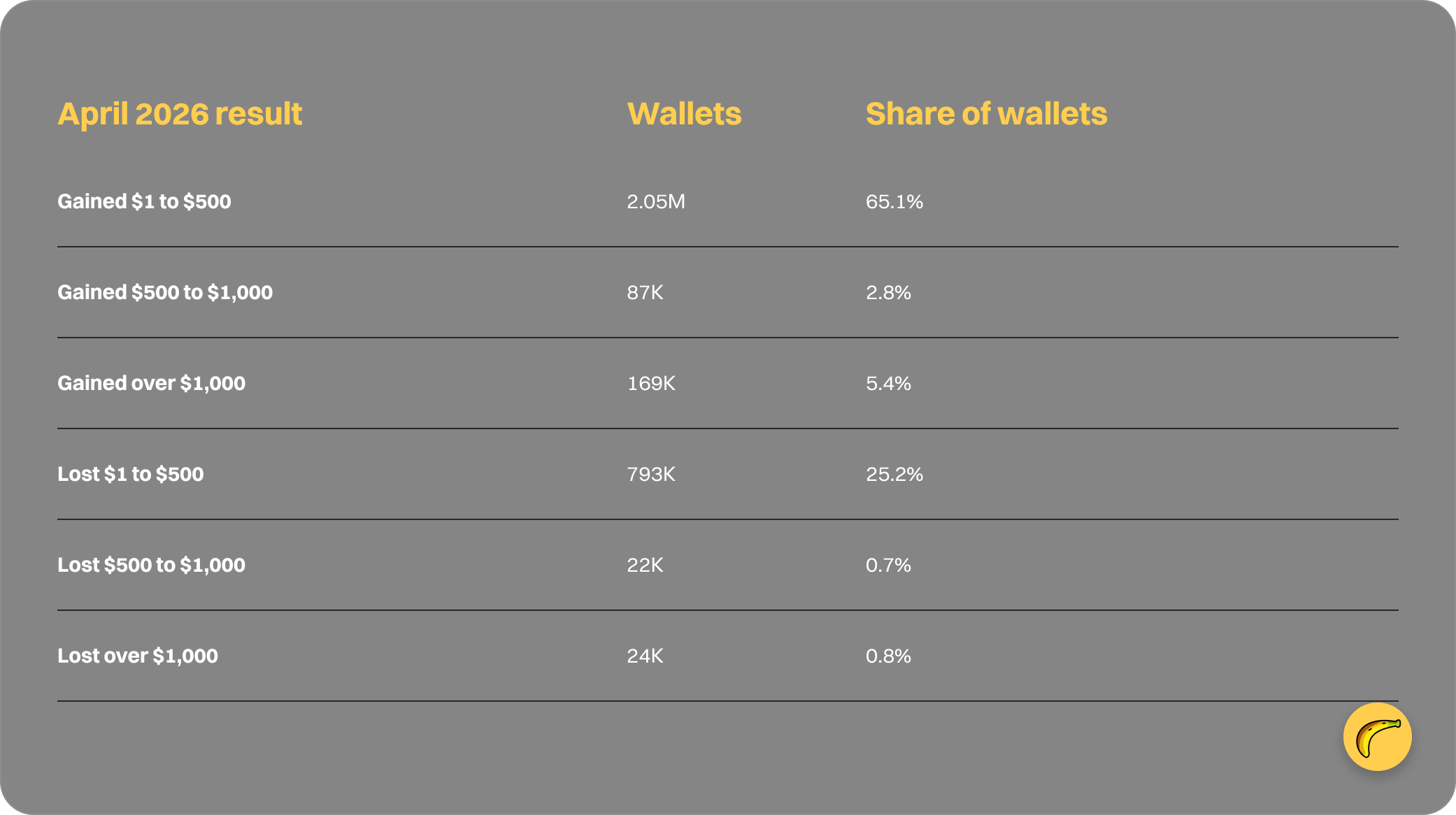
Most of the green is small. About two thirds of wallets made $500 or less that month, and 5.4% made more than $1,000.
On the losing side, 25.2% of wallets lost between $1 and $500, and 0.8% lost over $1,000.
Fees thin out small gains. At 1% per side on Solana, a round trip costs 2% before slippage, which is $4 on a $200 position.
A feed of callouts shows the trades people choose to post, which is not a sample of all trades.
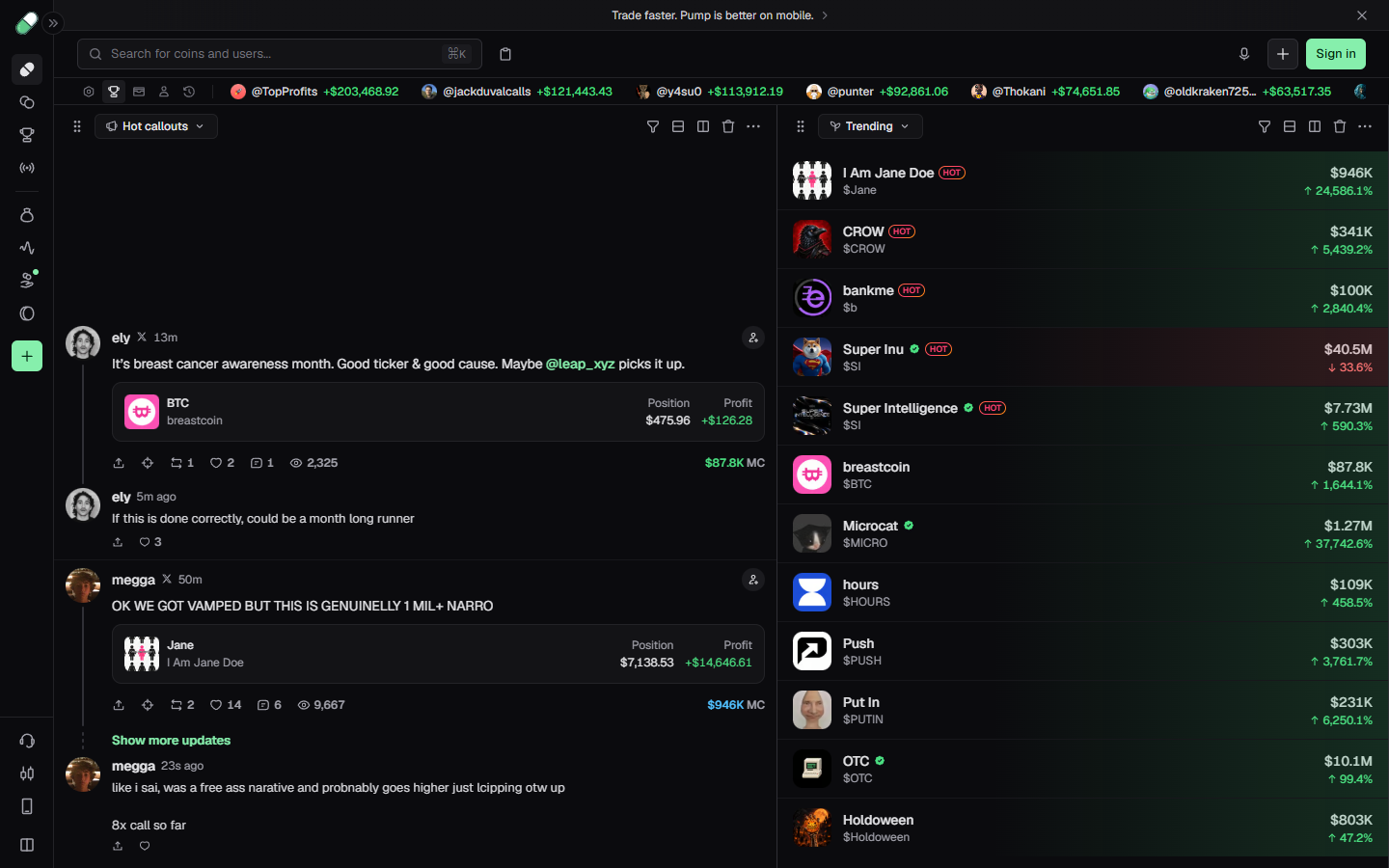
Pump.fun board on 1 October 2026: a trending coin list beside a feed of trader callouts and posted profits
What do the older datasets say about big wins and big losses?
Two earlier datasets look at different things, so they cannot be merged into one number.
BeInCrypto (5 June 2025) looked at 4.257 million addresses that traded more than 10 Pump.fun tokens in the previous six months. Around 2.4 million of them (56.6%) posted cumulative losses between $0 and $1,000.
The same piece reports nearly 1,700 addresses lost more than $100,000, and 46 wallets lost over $1 million. On the other side, only around 5,000 addresses made more than $100,000 and about 311 wallets passed $1 million. Read the BeInCrypto article for the full breakdown.
The headline says "60% of Traders Suffer Losses," but the 56.6% figure applies to one loss bracket, $0 to $1,000, among active traders. It is not the share of all wallets that lost money.
Cointelegraph (10 January 2025) reported that of 13.55 million Pump.fun wallet addresses, about 55,296 had realized profits above $10,000, and around 293 wallets (0.00217%) had realized more than $1 million. Its article, mirrored on TradingView, counts one thing: wallets that crossed $10,000 in realized profit.
That is not a loss rate. A dataset that counts who passed $10,000 says nothing about how many ended at a loss, so the 99.6% in the headline is not a share of traders who lose.
The same article carries pushback. Dune analyst Adam Tehc said that if you have realized $10,000 trading Pump.fun tokens you are in the top 0.412% of wallets. Pump.fun co-founder Alon said buys made after a token has bonded to Raydium are left out, so the true number of profitable wallets is "an order of magnitude LARGER."
What do these numbers not tell you?
CoinGecko's study and the Cointelegraph data count realized profits only. CoinGecko says so directly: it "excludes bagholders who never sold their tokens even if it crashes to zero," and it understates losses.
It lists two more limits. A wallet that bought Token A and sold an unrelated Token B in the same month appears profitable even if Token A is still held, and bot and wash trading has not been filtered out.
Add the period problem. The three datasets cover different windows: April 2024 to April 2026, roughly December 2024 to June 2025, and everything up to January 2025. None of them speaks for your next trade.
Copiers face one more gap. A copy trade fills after the copied wallet's trade, so on a fast move your price is worse than theirs. Banana Gun's docs warn that some target wallets buy pump-and-dumps or honeypots and use copiers as exit liquidity. Our post on why smart money is buying what everyone else is dumping covers the wallet-following side.
What separates the traders who keep their money?
None of these datasets explains why some wallets profit, so what follows is our view, drawn from how the mechanics work and not from the data.
Position size matters most. Using the calculator defaults on Solana (a 1% fee per Banana Gun's docs, 5% slippage and a 0.001 SOL tip on each side), a 0.5 SOL buy that falls 60% loses 0.324 SOL, and the same buy exited flat loses 0.060 SOL. Small buys survive a run of bad tokens.
Exit rules decide how much of a gain you keep. A token you bought at $150K needs $600K for 4x, and a take-profit that is never reached never sells. Banana Gun's sell limit orders let you set a Take Profit or Stop Loss, and a Trailing Stop Loss raises its trigger as the price makes new highs.
Selling in pieces can keep a winner from turning back into a loss. Plan the first sale at a multiple you set, and let the rest run with a trailing stop.
Checks keep you out of tokens you cannot sell. A honeypot is a token you can buy but cannot sell, and Banana Gun's pre-trade sell check blocks tokens you cannot sell before the buy. A honeypot check is not a rug check, so read the contract too, using our beginner guide to reading a token contract.
If you copy a wallet, use the limits. The copy trade settings include Max Buy, Buy Only Once, Tax Limit, Spending Limit and Min Market Cap and Max Market Cap. A market-cap ceiling also skips the wallet's larger-cap trades, winners included, which is the price of the protection. For more on how mirroring works, read what copy trading is and how wallet mirroring works.
Whatever you choose, decide the exit before the buy and only risk what you can lose. Nothing here is a promise that you will profit.
Frequently asked questions
What percentage of meme coin traders make money?
It depends on the month and the measure. CoinGecko Research found that 30.08% of Pump.fun wallets had positive realized PnL in June 2025 and 73.28% in April 2026, counting realized PnL only. Other studies measure different things, such as wallets above $10,000.
Do most Pump.fun traders lose money?
From April 2024 through late 2025, the majority of active Pump.fun traders ended most months in the red, per CoinGecko Research (updated 7 May 2026). In February to April 2026 the majority were in profit. The data stops at 30 April 2026.
Is it possible to make a living trading meme coins?
CoinGecko's April 2026 tiers show 5.4% of wallets made over $1,000 in that month, and 65.1% made $1 to $500. Cointelegraph reported about 55,296 of 13.55 million wallets with realized profits above $10,000 as of January 2025. None of these datasets measures income, but the tiers show how modest most gains were.
What is realized PnL, and why does it matter?
Realized PnL counts only gains and losses from tokens you have sold. A token you still hold at a deep loss does not show up, which is why CoinGecko says its study understates losses.
How do you avoid losing money on meme coins?
You can lower the odds of a large loss, not remove it. Size positions small, set exits before you buy, check the token before every buy, and cap what a copied wallet can spend on your behalf.
Place your trades with limits in the Banana Gun Telegram bot or on Banana Gun Pro.