


A meme coin profit calculator shows what you keep after the buy fee, the sell fee, slippage on both sides and the tip you pay on each trade. With the defaults below, a 0.5 SOL buy that rises 4x returns a profit of 1.265 SOL, not the 1.5 SOL the chart suggests.
Multiplying your buy by the price move ignores every cost on the way in and out. The gap between that number and your wallet balance is the part you can partly control.
Below are the calculator, its exact math, a 4x winner and a 60% loser worked through, and the settings that change the result.
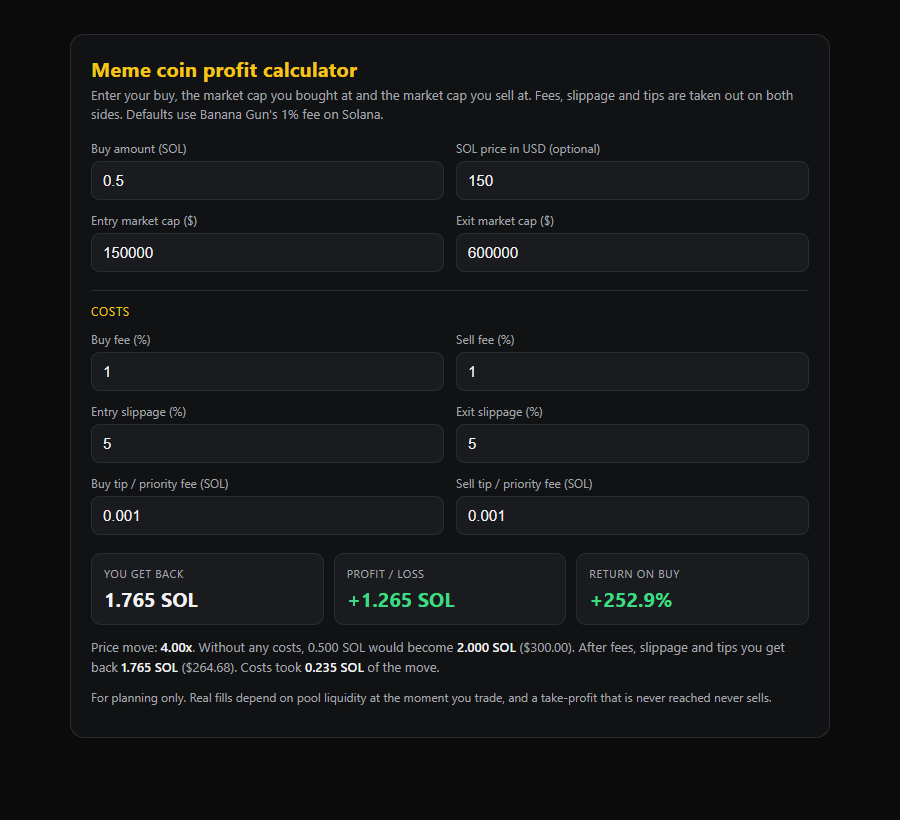
Meme coin profit calculator showing a 0.5 SOL buy from $150K to $600K market cap
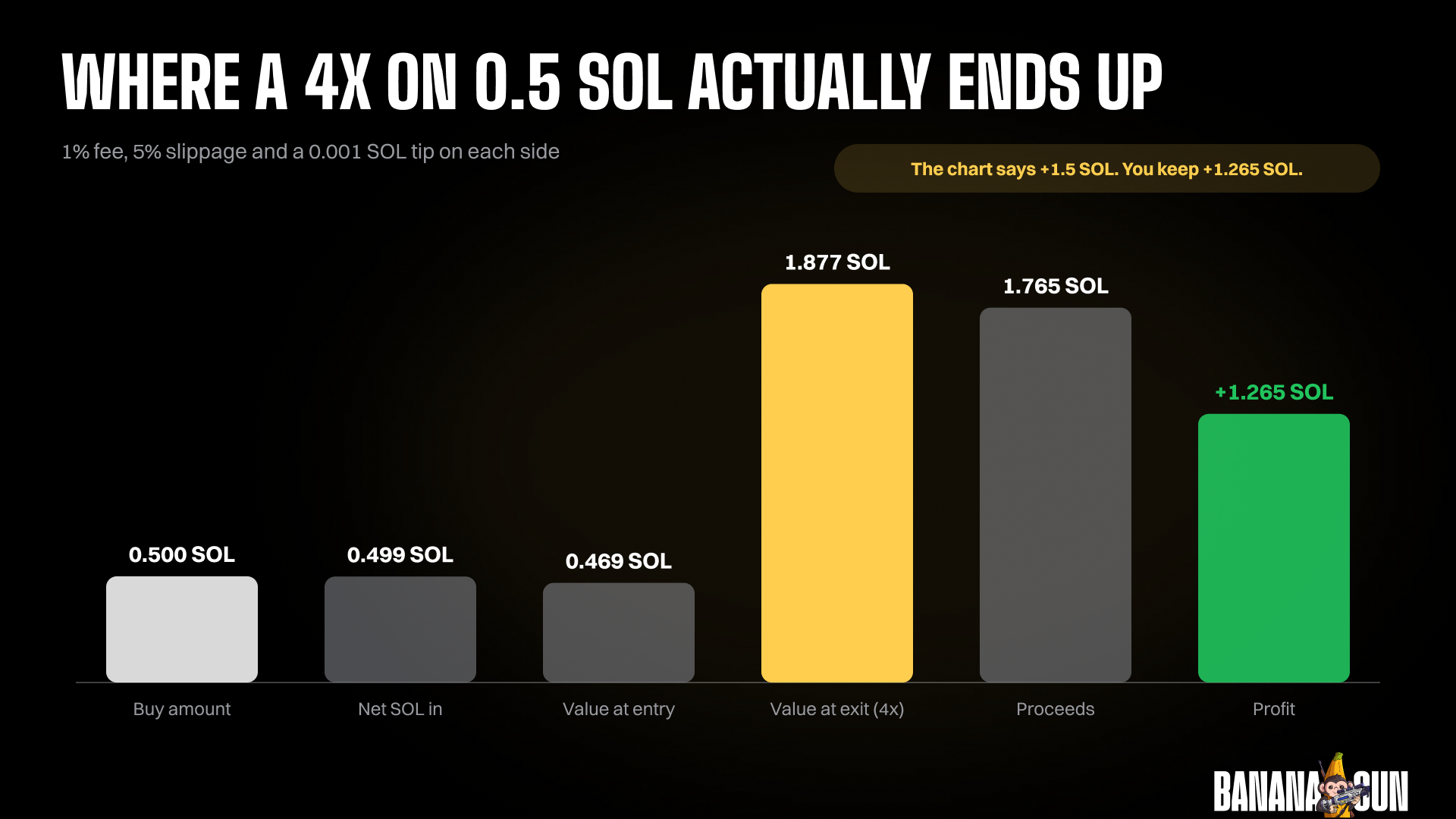
What does the meme coin profit calculator ask for?
[CALCULATOR EMBED: paste calculator-embed.html here (Webflow Embed element).]
You fill in the buy amount in SOL, the market cap when you buy, the market cap when you sell, the fee on each side, the slippage on each side and the tip on each side. The fee default is Banana Gun's 1% on Solana. The slippage and tip defaults are starting values, not Banana Gun settings.
Market cap stands in for price. That holds only while supply stays the same: a token at $150K that reaches $600K has multiplied its price by 4 if no new supply was created, and an SPL token with a mint authority can have more supply created.
How is meme coin profit calculated?
The calculator runs five steps in order.
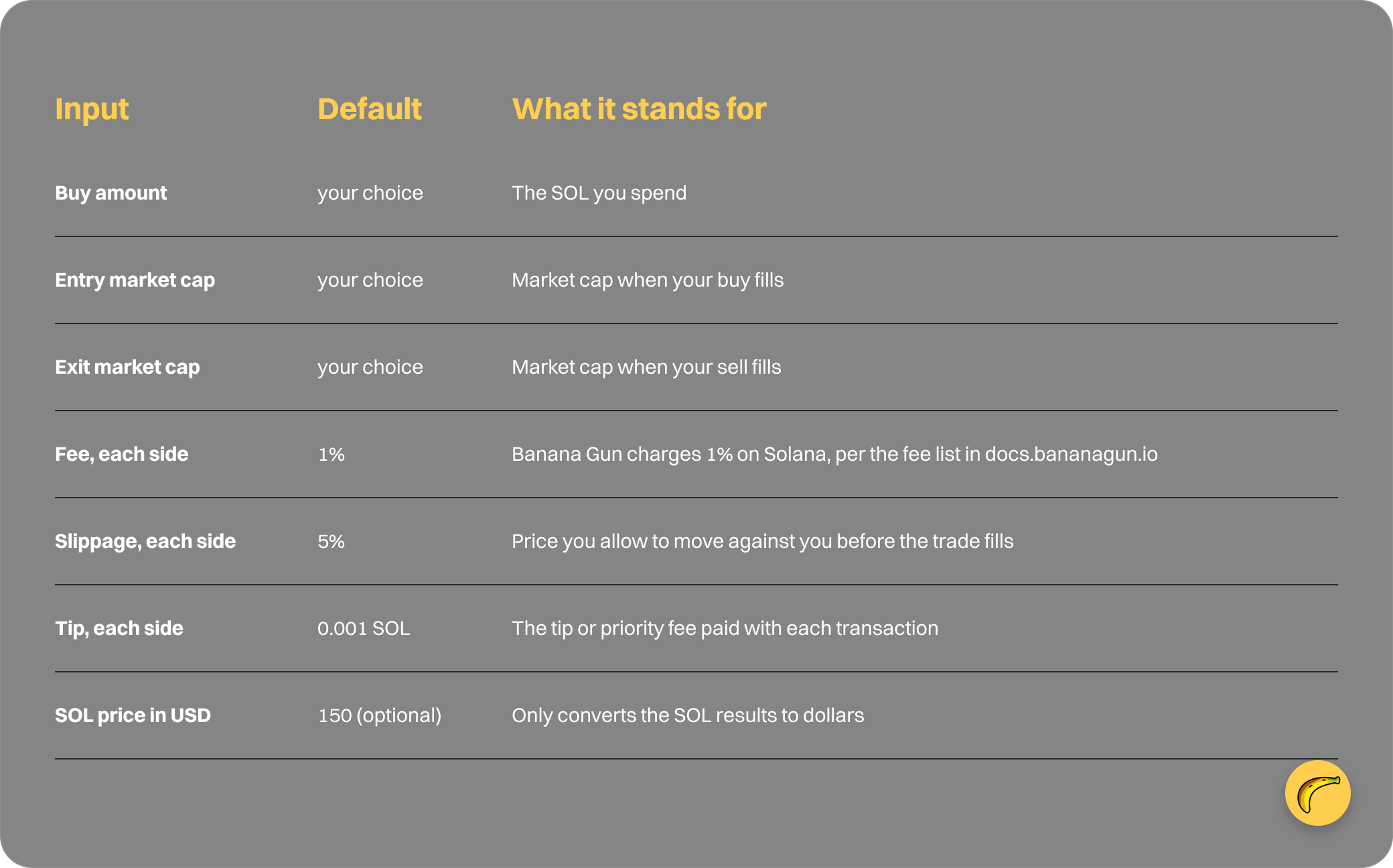
- Net SOL in = buy amount minus the tip.
- Token value at entry = net SOL in x (1 minus buy fee) x (1 minus entry slippage).
- Value at exit = token value at entry x (exit market cap divided by entry market cap).
- Proceeds = value at exit x (1 minus exit slippage) x (1 minus sell fee), minus the tip.
- Profit = proceeds minus the buy amount.
In words: you lose a little before you hold anything, the price move scales what is left, and you lose a little again on the way out.
The result covers only the cost inputs in the table. Any cost that is not on the list, or any price impact beyond the slippage you type in, is not in it.
Worked example 1: a 0.5 SOL buy that reaches 4x
You buy 0.5 SOL of a token at a $150K market cap and sell at $600K. A $150K token needs $600K for 4x. All numbers below use the defaults and are rounded to 3 decimals of SOL.
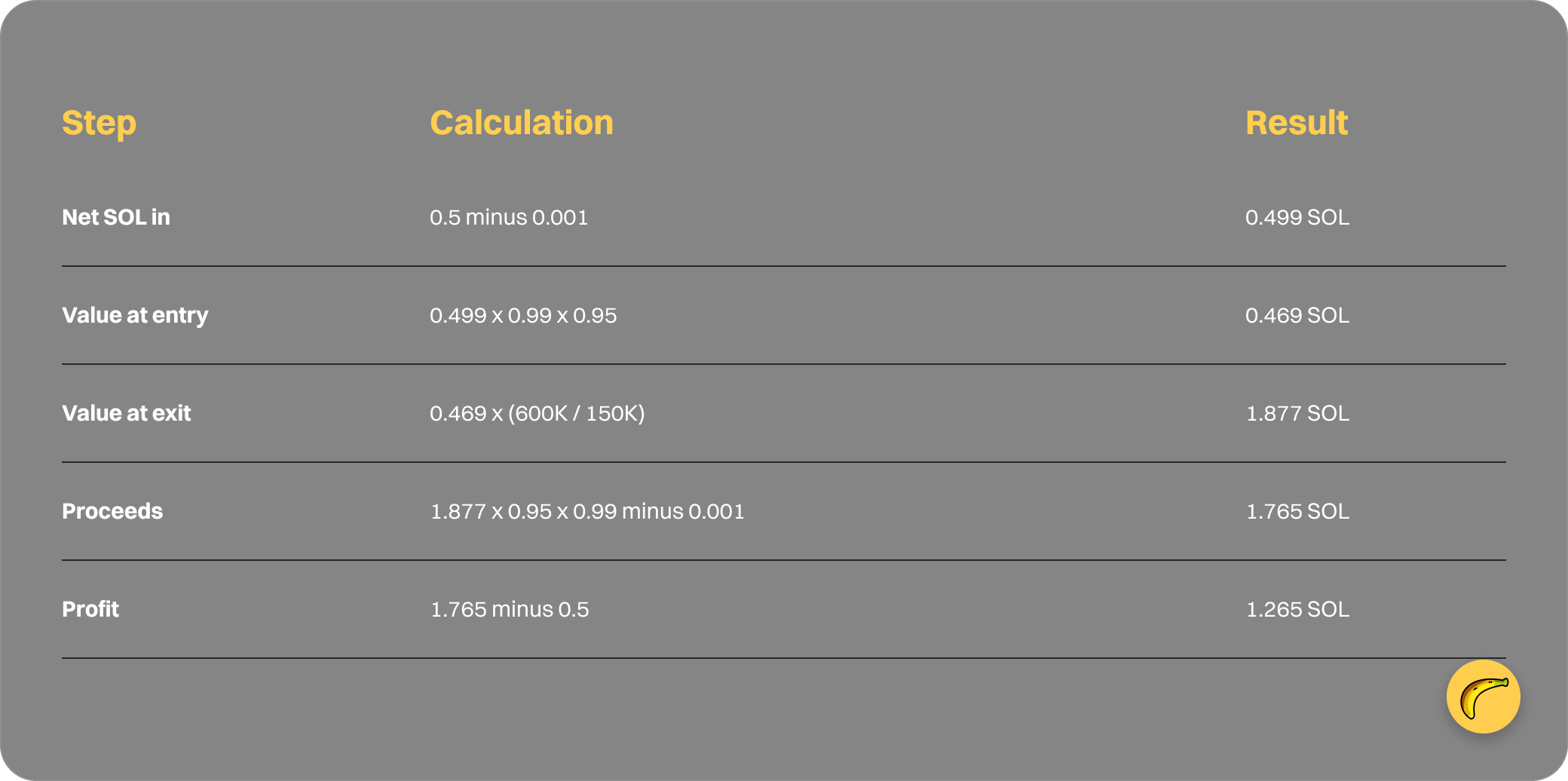
Without any costs, a 4x on 0.5 SOL would be a profit of 1.5 SOL. The costs took 0.235 SOL, about 16% of that headline profit.
The two 5% slippage cuts and the two 1% fees account for most of the gap. The tips cost 0.002 SOL in total, which is small on this trade.
Worked example 2: the same buy when the token falls 60%
Same buy, same defaults, but the market cap drops from $150K to $60K, a 60% fall. The exit multiple is 0.4.

A frictionless 60% loss on 0.5 SOL is 0.3 SOL. With costs you lose 0.324 SOL, so the costs add 0.024 SOL on top of the loss.
The costs come out of both results: the winner pays out less than the chart says, and the loser loses more.
How much does a meme coin have to rise to break even?
With the defaults and a flat exit at the entry market cap, the same 0.5 SOL buy returns 0.440 SOL. You are down 0.060 SOL on a token that did not move.
Solving the same five steps for zero profit gives a break-even multiple of about 1.135x. The token has to rise roughly 13.5% before your first SOL of profit appears.
That number moves with your settings. A volatile token that forces you to raise slippage pushes it higher.
How does slippage change a 4x?
Slippage is the price you allow to move against you before the trade fills, so what you allow is what you may pay. Banana Gun's Solana docs suggest raising slippage for volatile tokens, from 5% up to 10% or 30%, when a buy fails.
Here is the 4x example from above with slippage changed on both sides and nothing else touched:
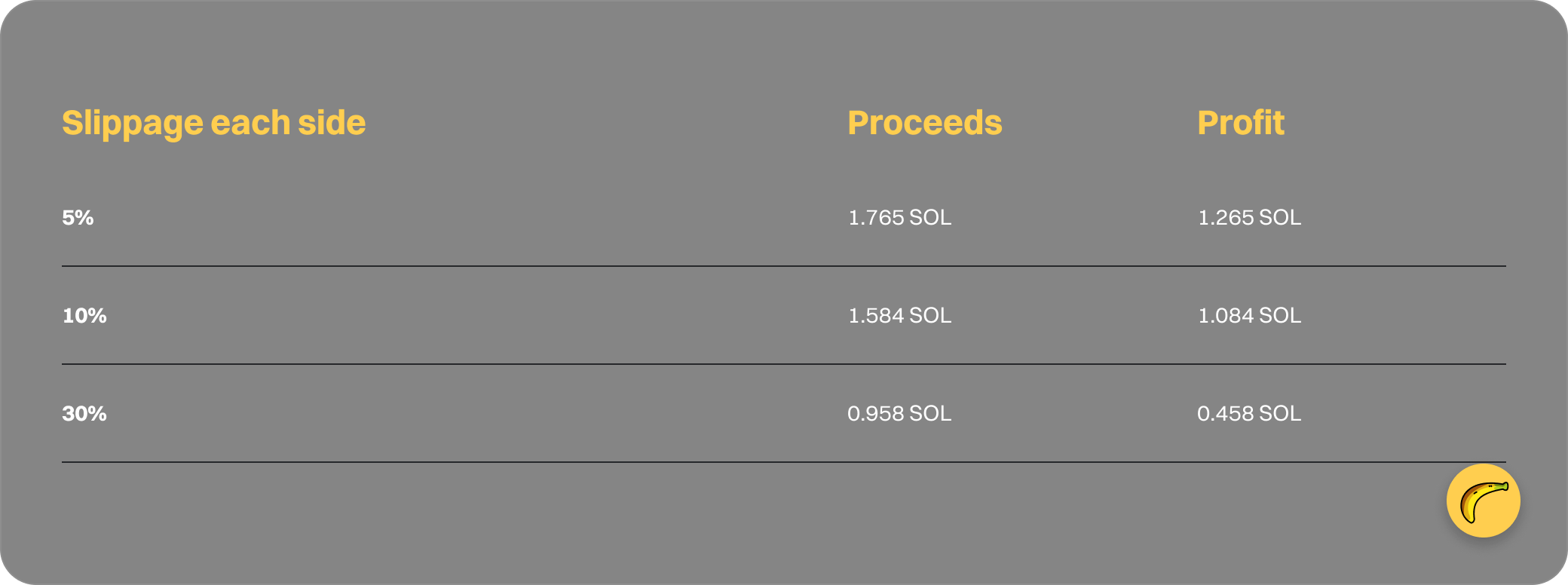
At 30% on both sides, the same 4x leaves you with a profit of 0.458 SOL, about 30% of the frictionless 1.5 SOL. Raising slippage to get a buy through is a real cost, so raise it only as far as the buy needs.
How do you keep more of the profit?
Four levers sit inside your control. The first three show up directly in the calculator.
Slippage is the largest cost in the examples above, at 5% a side against 1% fees. Start at the default and raise it only after a buy fails, then step it back down on the next trade.
The tip is a fixed amount, so it hurts small buys more. Tip 0.001 SOL on a 0.5 SOL buy is 0.2% of the buy. On a 0.05 SOL buy it is 2%, and the 4x in the table above would return a profit of 0.122 SOL instead of the frictionless 0.15 SOL.
Banana Gun runs anti-MEV protection by default, using private transactions, and Jito on Solana. To see what that protects against, read what MEV is and how it eats into every on-chain trade.
The fee is 1% on Solana per the docs, and every round trip pays it twice, so trading less often costs less. For the full picture of what bots charge, see how Telegram trading bots work and what they cost.
The fourth lever is your exit plan. A take-profit order sells a share at a market cap you choose, and a take-profit never reached never sells. Splitting an exit into two sells adds a second tip, which under the defaults is another 0.001 SOL.
If you sell half at 2x and the other half rides to 4x, you have banked something even if the token then falls. The calculator can model each leg separately with the same inputs.
What the calculator cannot tell you
The calculator assumes your sell fills at the exit market cap you typed. On a thin pool, selling a large position can move the price against you by more than the 5% you typed in, and the real exit lands below the result.
It also cannot tell you whether you can sell at all. A honeypot is a token you can buy but cannot sell, and no input in a profit calculator catches that. Check the token before you buy.
A copy trade fills after the copied wallet's trade, so on a fast move your entry market cap is higher than theirs, and the calculator should use yours, not theirs.
Frequently asked questions
How do you calculate meme coin profit?
Take your buy amount, remove the tip, the buy fee and entry slippage to get the token value at entry. Scale that by the market cap ratio, then remove exit slippage, the sell fee and the exit tip. Subtract your original buy for the profit.
What is the Banana Gun fee on Solana?
The docs list 0.5% for Ethereum manual buys and limit orders and 1% on other chains, including Solana, per docs.bananagun.io. The calculator defaults to 1% each side for that reason.
What does 4x mean in market cap?
A 4x means the market cap is four times your entry. A token you buy at $150K needs $600K, and a token you buy at $5M needs $20M. In sell limit orders, +300% is the same thing as 4x.
Why is my real profit lower than the calculator says?
The calculator uses the slippage and tip you type in. If your fill used more slippage, or the pool was thin enough that your sell moved the price, the result will be lower. Check your fills in the bot against your inputs.
Does the calculator include network fees?
It has no separate network fee input. The tip is the only per-transaction cost it models, so compare the estimate with your real balance after the trade and adjust the inputs to match.
Run your next trade through the calculator first, then place it in the Banana Gun Telegram bot or on Banana Gun Pro.