
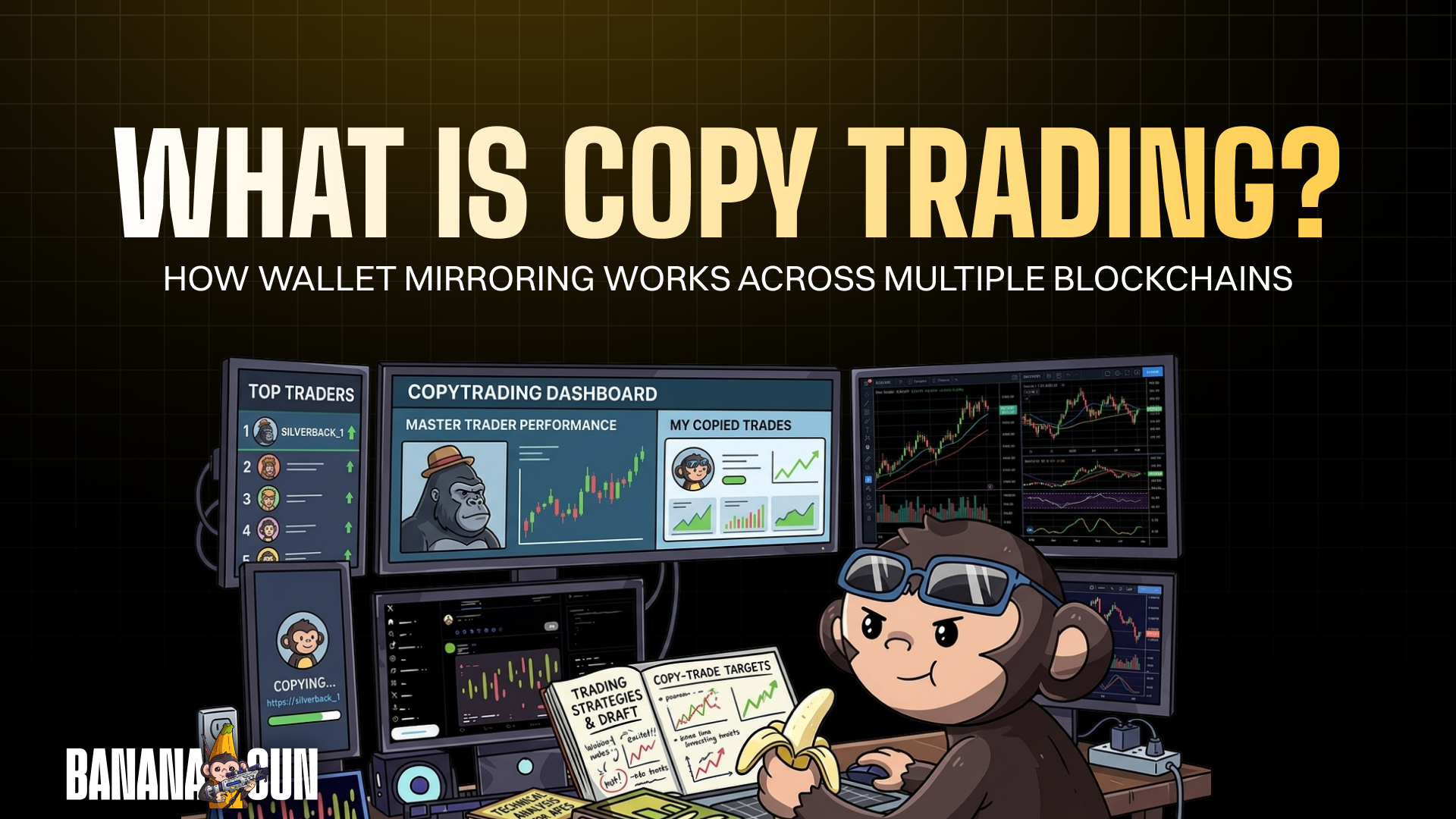
Copy trading is the practice of automatically replicating another trader's positions in real time, so that when they buy, you buy, and when they sell, you sell. No manual entry. No watching charts. Your account mirrors every move of a chosen trader or wallet, proportionally or at a fixed amount you control. The concept has existed in traditional finance for over a decade. On-chain, it works at a fundamentally different level, and the gap between the two versions is worth understanding before you commit capital to either.
Copy Trading in Traditional Finance vs On-Chain
The traditional model, made popular by platforms like eToro, works like this: you allocate capital, browse a marketplace of verified traders ranked by their historical returns, and choose one to follow. The platform automatically mirrors that trader's stock or forex positions in your account, scaled to your portfolio size. Simple enough, but the limitations are structural.
You can only copy traders registered on that same platform. You are limited to the asset classes the platform supports, which means stocks, ETFs, and forex. The information available about each trader is curated by the platform, so you are trusting their ranking methodology as much as the trader themselves.
On-chain copy trading removes every one of those constraints. You do not copy a platform user. You copy a wallet address on any public blockchain. That wallet could belong to a solo trader running a proven strategy, a known market maker, a team of analysts, or an anonymous account you spotted in a token analytics feed. None of them need to know you are watching, let alone copying.
Asset scope is the other major difference. On-chain copy trading works across thousands of tokens that do not exist on any centralized platform. If you identify a wallet consistently early on new Solana or Base launches, you can mirror their exact entries automatically, using on-chain crypto trading platforms that monitor the blockchain in real time rather than relying on an order book with its own settlement delay.
Research responsibility is the real tradeoff. There is no curated leaderboard with audited returns. You identify which wallets are worth following. That front-loaded work is where most of the alpha actually lives in crypto copy trading.
How On-Chain Copy Trading Actually Works
The mechanism is not complicated once you strip away the abstraction. You provide a wallet address. The system watches that address for new outgoing transactions on the blockchain. When the wallet sends a buy transaction for a token, your account fires the same buy using parameters you configured in advance: how much to spend, what slippage to allow, whether to apply MEV protection, and when to take profit or cut the loss.
Execution is automatic. You do not need to be logged in, watching a screen, or even awake.
Banana Pro structures this across three tiers of increasing control:
Simple handles the basics: wallet address, a maximum spend per copied trade, and take profit or stop loss levels. This is the right starting point when you want to test a wallet before committing to a more specific configuration.
Advanced adds four execution modes. Buy Once prevents repeated entries into the same token, useful if the wallet is averaging into a position and you only want one entry. Exact Amount mirrors the wallet's precise transaction size. Percentage copies a proportion of whatever the wallet spends. Fixed sets a constant amount per trade regardless of what the wallet puts in. Advanced also adds market cap filters so you skip tokens below or above a threshold, plus selective sell copying so your account exits when the wallet exits rather than holding independently.
Advanced with Presets adds one more layer: you save a complete configuration as a named template and apply it to new wallets with a single click. If you have a working setup for copying early-stage Solana launches, that exact configuration deploys to a new wallet immediately without re-entering every parameter.
Cross-chain operation is built into the same interface. A wallet you configure in Banana Pro can mirror trades across Solana, Ethereum, BNB Chain, Base, and MegaETH simultaneously. If the wallet you are copying trades across multiple chains, your copy setup follows them without requiring separate configurations per chain. A wallet active on both Solana and Base would otherwise require two separate setups on any platform that does not handle this natively.
Finding Wallets Worth Copying
Execution is the easy part. The harder problem in crypto copy trading is identifying which wallets are actually profitable, as opposed to wallets that had one spectacular trade and have been bleeding ever since.
You need to evaluate consistency across multiple positions, the diversity of tokens they have traded, whether their exits are disciplined or they hold through full drawdowns, and whether their edge scales. A wallet that buys $500 positions may not perform the same way when you are mirroring $5,000 entries into the same tokens with thinner liquidity depth.
Banana Pro's Top Traders widget surfaces the 50 highest-PnL wallets for any token you are viewing. You can see exactly what they bought, what they sold, their realized and unrealized PnL, how much they still hold, and their activity pattern. A single click opens the copy trade configuration for that wallet address. The path from discovery to active copy takes seconds.
Wallet Tracker works the other direction. You already know a wallet you want to watch, perhaps from community research, a strong trade you spotted, or your own on-chain analysis. Add their address to the tracker, assign a label you will recognize, and their activity surfaces in real time. When they move, you can jump directly from the tracker to a trade without hunting for the token separately.
There is a verification step that matters before you copy any wallet: confirm it is not a developer's proxy account. Developers sometimes hold tokens through addresses that look like active traders but are actually seeding their own liquidity or masking insider positions. The Bubble Map widget, powered by iNSIGHTX, visualizes holder clusters for any token and flags proxy wallets masking token origins. If the wallet you found turns out to be a cluster node connected directly to the developer's address, you are not copying a trader. You are copying someone who can exit at any moment and leave you holding a worthless position. Check the Bubble Map before you commit.
Understanding how Pump.fun launches work also helps here. A large share of wallets worth copying are active in the pre-migration phase of new token launches, and the mechanics of that phase directly affect their entry and exit behavior. Knowing the context makes it easier to judge whether their historical PnL reflects repeatable skill or one-time timing.
Copy Trading Speed: Why Milliseconds Matter
The defining constraint in on-chain copy trading is not configuration complexity. It is time.
When a wallet you are copying buys a newly launched token with thin liquidity, the price moves the moment that transaction lands. If your copy trade executes in the same block, you get close to the same price. If it takes three seconds, you might pay 20 to 30 percent more for the same token the original wallet bought at a fraction of the cost. On small-cap launches, that gap often determines whether the copied trade is profitable at all.
On Base, Banana Gun delivers Flashblock copy trading at 200ms granularity, executing at block zero. That is the fastest copy trade execution window available on Base. Block zero means your transaction is included in the same block as the original wallet's trade, before the price has time to move from other buyers reacting to the same signal.
MegaETH operates at 100,000 transactions per second with millisecond block times. Banana Pro's routing engine was rebuilt specifically for MegaETH's sequencer architecture, achieving sub-100ms execution. At that speed, the timing disadvantage of being a follower becomes negligible. Your copy trade lands almost simultaneously with the original wallet's transaction.
On Solana and Ethereum, copy trade execution is fast but subject to each chain's block time constraints. Chain selection matters when you are evaluating whether a particular copy trading strategy is viable. A strategy that depends on sub-second entries needs a chain where sub-second entries are technically possible. For a deeper look at how Solana trading bots handle execution speed, the mechanics there apply directly to copy trade latency on that chain.
Risk Management in Copy Trading
Copy trading does not eliminate risk. It transfers the research burden from which token to buy to which wallet to follow, and both decisions carry the same potential for loss. Even a wallet with an exceptional track record will have losing trades, and your results will differ from theirs based on timing, position sizing, and token liquidity relative to your entry size.
Market cap filters are the first line of defense. Setting a minimum market cap for copied trades means you skip ultra-low-cap launches where slippage and liquidity risk are highest. You will miss some of the largest percentage gains, but you will also avoid the tokens that collapse in the first 20 minutes of trading.
Maximum spend per copy trade caps your exposure on any single position. A wallet managing $100,000 might put $10,000 into a position representing 10 percent of their portfolio. The same $10,000 from you might be your entire account. Set your copy size to a percentage of what you are willing to lose on a single bad trade, not what the wallet is spending.
Selective sell copying ties your exit to theirs. Without it, you are responsible for choosing when to exit a position you did not analyze yourself. A wallet that exits 80 percent of a position at a 5x gain and holds the remainder is still a profitable trade if you follow both moves. If you only copied the buy and held independently to zero, the outcome is entirely different.
Take profit and stop loss on every position are non-negotiable, especially on new token launches where volatility is extreme in both directions. Set them before the position opens. Copy trading works best as a structured, rule-based activity rather than a reactive one. You can configure your first copy trade on Banana Pro at pro.bananagun.io, starting with the Simple tier before moving to advanced execution modes.
Frequently Asked Questions About Copy Trading in Crypto
What is copy trading in crypto?
Copy trading in crypto means automatically mirroring the on-chain transactions of a specific wallet address. When that wallet buys or sells a token, your account executes the same trade using your configured spend limits and risk parameters. Unlike traditional copy trading platforms that only let you copy registered users, on-chain copy trading lets you follow any wallet on any blockchain, including wallets you discover through analytics tools.
Is copy trading profitable?
Copy trading can be profitable, but the outcome depends entirely on the wallet you choose to copy. A wallet showing strong historical PnL does not guarantee future performance. Key factors that affect your results include entry timing relative to the original wallet, slippage on lower-liquidity tokens, position sizing relative to what the wallet is running, and whether that wallet's edge holds at your capital size. Market cap filters, stop-loss settings, and selective sell copying reduce the downside of any single copied position.
Can you copy trade across different blockchains?
Yes. Banana Pro runs cross-chain copy trading across Solana, Ethereum, BNB Chain, Base, and MegaETH simultaneously from a single configuration. A wallet you set up to copy on Solana can also be mirrored on Ethereum and Base without separate setups. This means you can follow a multi-chain trader without manually tracking which chain they are active on at any given moment.