
Solana has more trading bots competing for the same order flow than any other chain in crypto. Most execute fast enough now that speed alone rarely decides a trade.
What separates them is what runs automatically, before you ever notice there was a risk to manage. A protection buried in a settings menu did not protect you on the trade where it mattered, because you forgot it was there.
If you're weighing a Telegram bot against a full trading terminal, that tradeoff is covered in this comparison of telegram trading bots vs DEX interfaces.
What Actually Makes a Solana Bot Good
A good Solana trading bot in 2026 is judged by what protections run by default, not by how fast it sends a transaction. Banana Gun ships honeypot detection, anti-MEV routing through Jito, Anti-Rug and Anti-Rug GWEI at an 80 to 85 percent success rate, and copy trading with wallet-level limits, all active out of the box.
That default-on posture matters more on Solana than almost anywhere else. New tokens launch by the thousand, and the gap between a good trade and a bad one is measured in milliseconds, not menu clicks.
Honeypot Detection and Anti-MEV Routing, Default Not Discovered
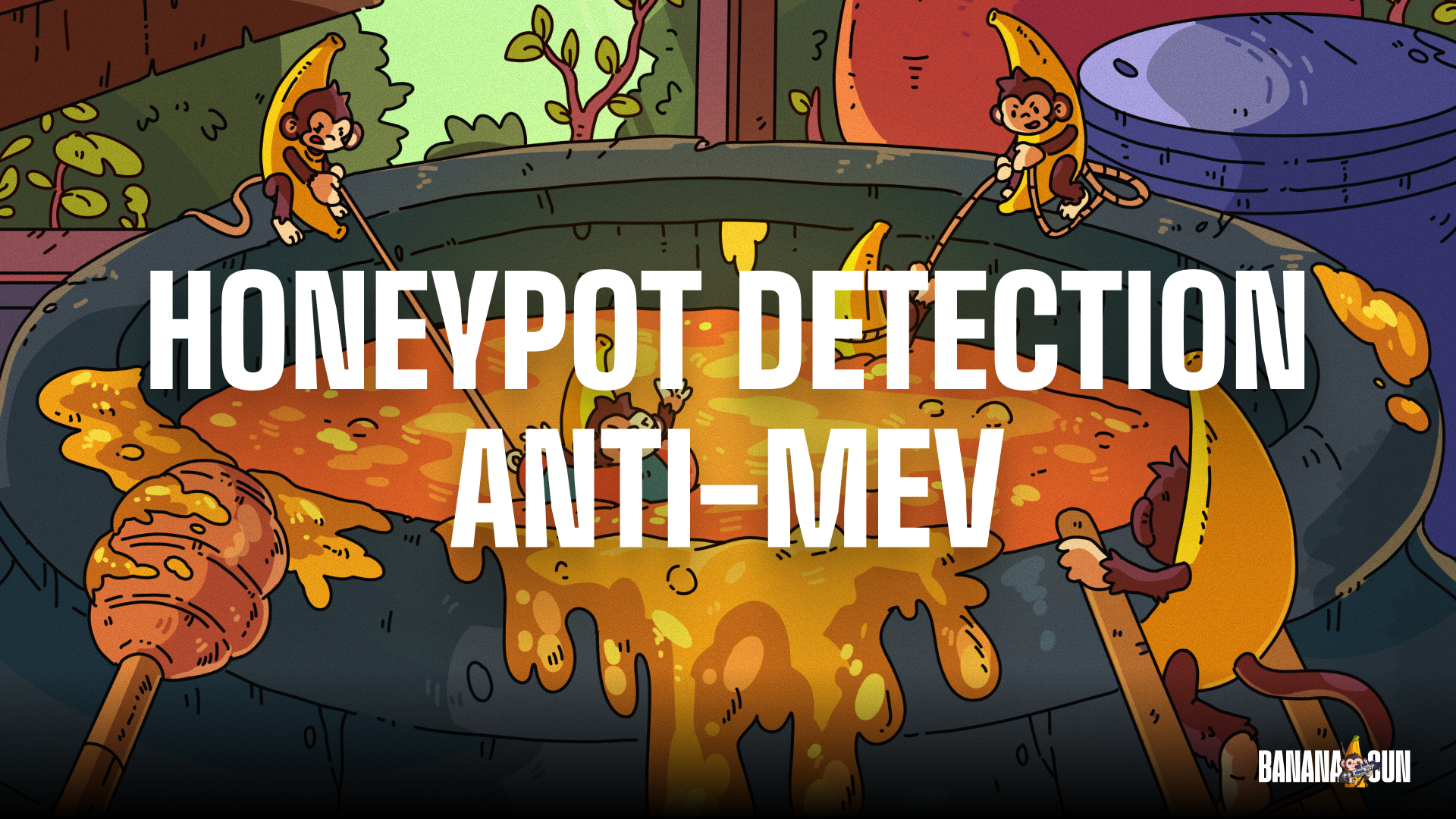
A honeypot is a contract built so you can buy a token but never sell it. On Solana, where new tokens launch nonstop, skipping that check even once is a real risk.
Banana Gun runs a pre-trade sell check on every trade as a default behavior, not a button you have to remember to press.
Solana's speed carries its own tax too. Validators and bots can reorder or front-run your transaction inside the same block, which is the hidden cost of MEV.
Banana Gun routes Solana trades through Jito with anti-MEV protection active by default. You don't toggle it on after a bad fill teaches you it existed. It runs on the trade that mattered before you knew it mattered.
Anti-Rug and Anti-Rug GWEI: Reading the 80 to 85 Percent Number
Rug pulls remain the most common way new Solana traders lose a position, usually within minutes of a launch. Anti-Rug and Anti-Rug GWEI are Banana Gun's tools for that specific problem, and both carry an 80 to 85 percent success rate.
Read that number for what it measures: rug detection, not general trade safety. A tool succeeding 80 to 85 percent of the time still leaves real trades where it does not catch the exit in time.
What it does tell you is that the tool does meaningful work automatically, on most trades, without you watching a chart waiting for a liquidity pull.
Copy Trade Controls: Modes and Limits
Copy trading lets you mirror a wallet's trades automatically, and it works the same way across every chain Banana Gun supports. If you haven't used it, this guide to copy trading covers the basics.
Banana Gun offers three copy trade modes: Simple, Advanced and Advanced Presets. Alongside them sit exposure limits: Buy Fixed, Buy Only Once with a seven day block on repeat entries from the same wallet, and Min and Max Market Cap filters.

What to Check Before You Fund a Wallet
Don't start by comparing advertised execution speeds. Start by asking what runs without you switching it on: honeypot checks before every trade, MEV protection by default, and copy trade limits that cap exposure automatically.
Banana Gun answers yes to all three on Solana, at a 1 percent fee. Ethereum manual buys and limit orders run at 0.5 percent, the lowest fee tier across the chains it supports.
The platform has processed more than 26 million lifetime trades and over $16 billion in lifetime volume across more than 1.5 million users, enough history to test these defaults rather than just advertise them.
If you want to see how those defaults behave on your own trades, start inside Banana Gun and compare what runs automatically against whatever bot you're using now.