


Whenever you submit a trade on a decentralized exchange, it briefly sits in a public queue called the mempool before being confirmed. During that time, automated bots scan pending transactions looking for ways to profit from them. Understanding MEV helps explain why the price you receive can differ from the price you expected.
What does MEV mean?
MEV stands for Maximal Extractable Value (formerly Miner Extractable Value). It refers to profits that validators or third-party bots can generate by reordering, inserting, or censoring transactions within a block. The term was formalized in the 2019 research paper "Flash Boys 2.0" by Daian et al., which quantified how much value was being systematically extracted from ordinary traders on Ethereum.
MEV is not a bug or an exploit in the traditional sense. It is an emergent property of transparent mempools combined with the ability of validators to choose transaction ordering. On Ethereum alone, cumulative MEV extracted since 2020 has been measured in the hundreds of millions of dollars, according to data from Flashbots Research.
What is front-running and how does it work on-chain??
Front-running happens when a bot detects your pending trade and submits its own transaction with a higher gas fee to execute before yours.
The bot buys first, your order pushes the price higher, and the bot immediately sells for a profit. The difference between the quoted price and the price you actually pay is the value extracted from you.
This is most common on low-liquidity tokens, where even small trades can significantly move the market.
What is a sandwich attack?
A sandwich attack is one of the most common forms of MEV targeting retail traders. The attacker places one transaction before your trade and another immediately after it. The first transaction pushes the price up, your order executes at the inflated price, and the attacker sells into the price increase they created.
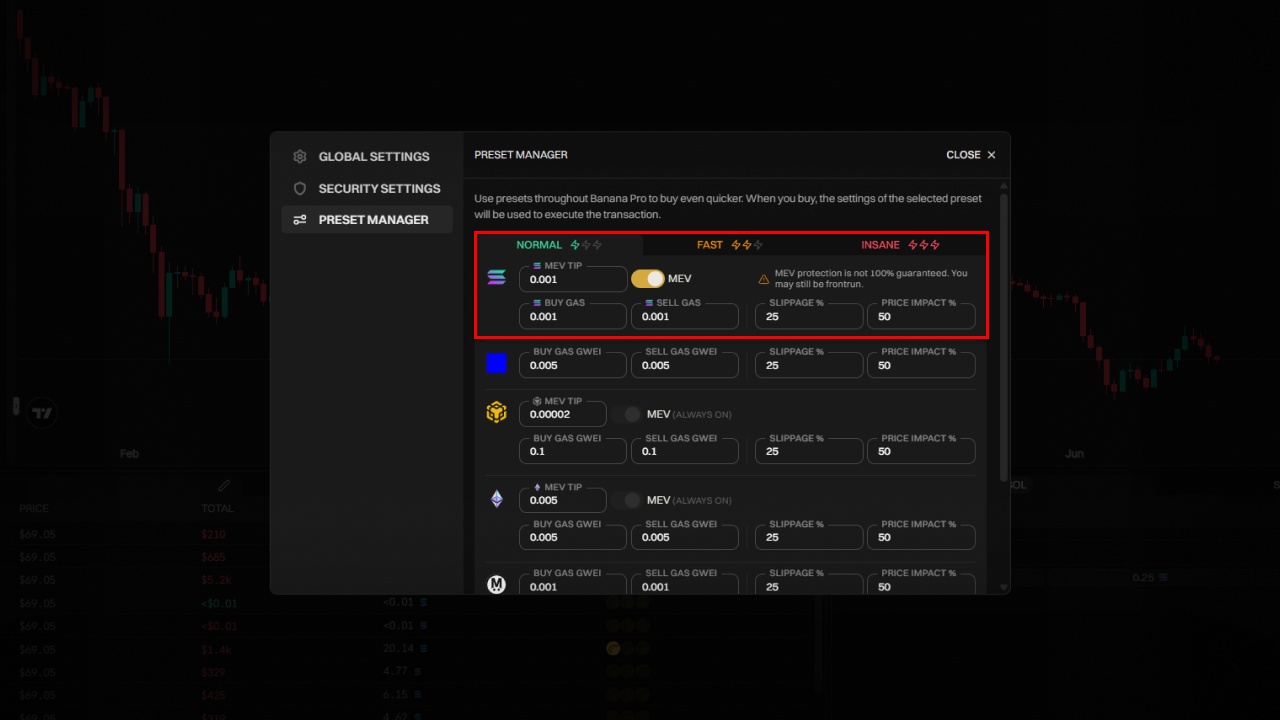
Your slippage setting plays a major role here. Lower slippage limits how much value bots can extract, while very high slippage settings create a larger opportunity for attackers.
How does MEV affect your actual trade price?
The impact depends on three factors: the token's liquidity, the size of your order, and your slippage settings.
On highly liquid pairs like ETH/USDC, MEV is usually negligible for retail traders. On newly launched or low-liquidity tokens, larger orders are much more attractive targets.
MEV also includes arbitrage and liquidation bots. These don't directly target your trades like sandwich attacks do, but they contribute to the highly competitive environment around on-chain execution.
What is built-in MEV protection and how does it work?
MEV protection routes your transaction through a private channel instead of broadcasting it to the public mempool. If bots can't see your transaction, they can't front-run it or build sandwich attacks around it.
The result is execution that's much closer to the quoted price without adding any extra complexity for the user.
Banana Pro, the web terminal at https://pro.bananagun.io/app, runs MEV protection automatically on every trade. The system also scans for contract changes and suspicious functions in real time, so you get a live alert if a token contract is modified after you open a position. Both protections are automated and require no coding knowledge or manual configuration from you.
How do you reduce your MEV exposure as a trader?
Four practices reduce MEV exposure meaningfully:
- Use a private mempool or MEV-protected routing. Tools that route through private channels eliminate the front-running window entirely.
- Set tighter slippage on liquid tokens. The wider your slippage tolerance, the wider the window sandwich bots have to work with. On liquid tokens, 0.5-1% is usually sufficient.
- Avoid trading tokens with thin liquidity at large position sizes. High price impact plus high slippage is the combination bots are hunting for.
- Break large orders into smaller pieces. A single $20,000 buy is a much more attractive sandwich target than four $5,000 buys spaced a few seconds apart. The DCA feature in bots like Banana Gun automates this without requiring manual timing.
For traders who want MEV protection without the DEX interface learning curve, Banana Gun gives you the same underlying protection from the Telegram interface, which many traders prefer for speed and on-the-go access.
Frequently Asked Questions
What does MEV stand for in crypto?
MEV stands for Maximal Extractable Value. It refers to the profit that block producers or bot operators can extract from the transaction ordering process in a blockchain block. The term was originally Miner Extractable Value but was updated after Ethereum moved to proof-of-stake.
Can MEV protection completely eliminate front-running?
MEV protection via private mempool routing eliminates the most common front-running vector because bots cannot target transactions they cannot see. It does not protect against every form of MEV, such as arbitrage between pools, but sandwich attacks and classic front-running are effectively blocked when your transaction bypasses the public mempool.
Does MEV protection slow down my trades?
No. Private mempool routing adds no meaningful latency to order execution. The transaction goes directly to block builders who include it in the next available block. You may occasionally see slightly different gas dynamics, but execution speed is not reduced.
What is a sandwich attack in crypto?
A sandwich attack is a form of MEV where a bot places one buy transaction immediately before your trade and one sell transaction immediately after, both in the same block. It profits from the price movement your order creates. You end up paying a higher price than quoted, and the bot captures the difference.
How do I know if my trade was sandwiched?
Compare the expected price at submission to the actual execution price from the on-chain transaction receipt. If you received significantly fewer tokens than the quoted amount and your slippage tolerance was wide, a sandwich attack is a likely explanation. Block explorers can show the surrounding transactions in the same block to confirm.