
A rug pull is when the people behind a token pull the liquidity or dump a large hidden stake, and no single rug pull checker catches every one. Five free checks cover the common routes: contract match, liquidity lock, mint power, holder concentration and the deployer wallet. A clean result on all five lowers the risk and does not remove it.
Each check below says where to look and what a bad result is. The last section covers what Banana Gun's Anti-Rug does and where it stops.
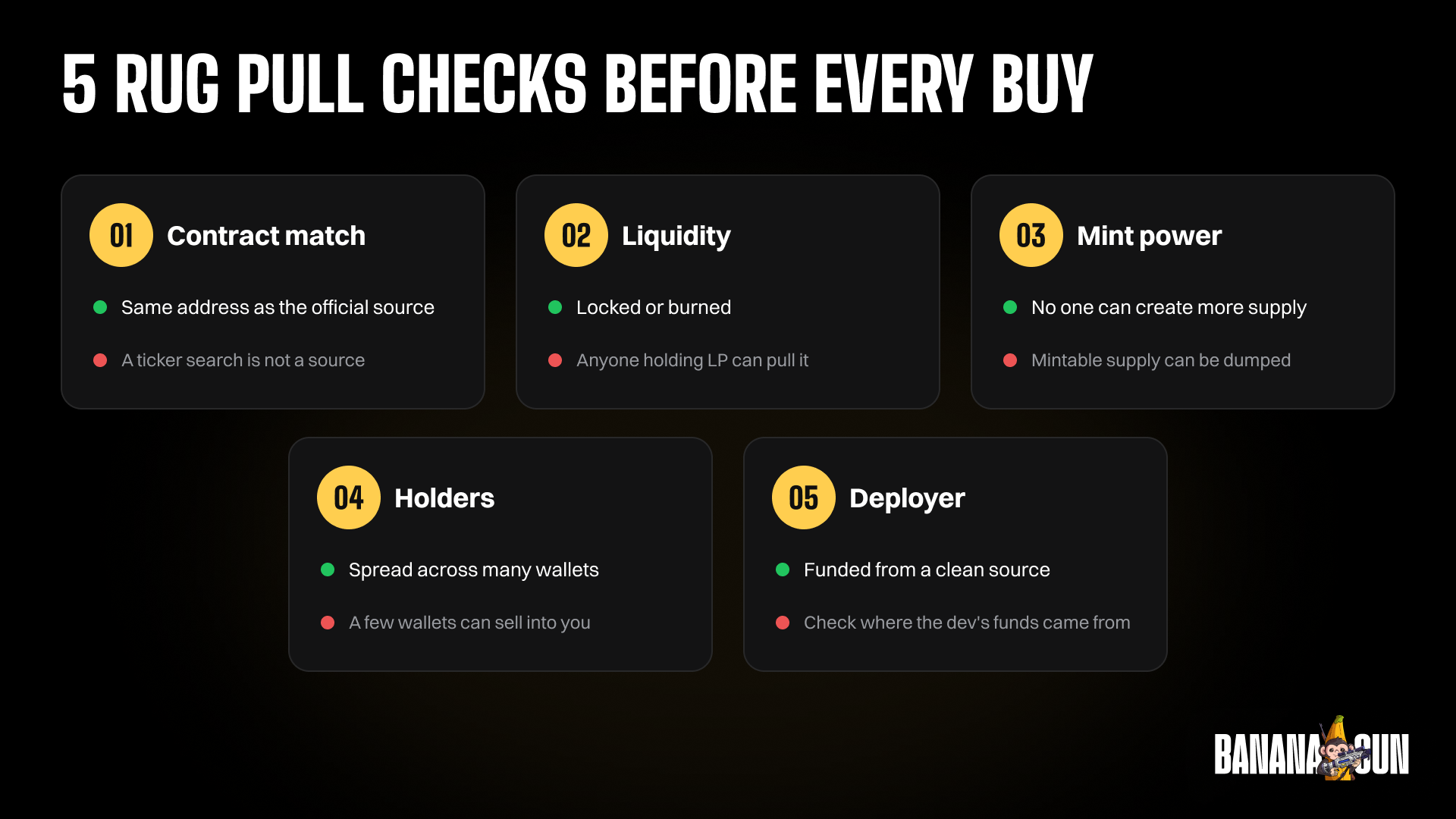
Check 1: Confirm the contract matches the source
Look at: the full contract address of the token you are about to buy.
Where: the project's own link, or the row on Banana Gun Pro, compared against the address in your checker.
Bad result: the address in your checker differs from the address in the source, even by a few characters. A ticker search is not a source.
Example: a search for VRAX on the Robinhood Chain explorer on 1 October 2026 returned at least five different token contracts named VRAX, including one called "VRAX holder Airdrop Now". Banana Gun Pro's Robinhood Trending page listed VRAX at a $4.1M market cap with a contract starting 0x33 and ending 1e44, which matched none of the five search results. Match the full address, then run every other check on that exact one.
Check 2: See whether the liquidity is locked or burned
Look at: who controls the liquidity, and for how long.
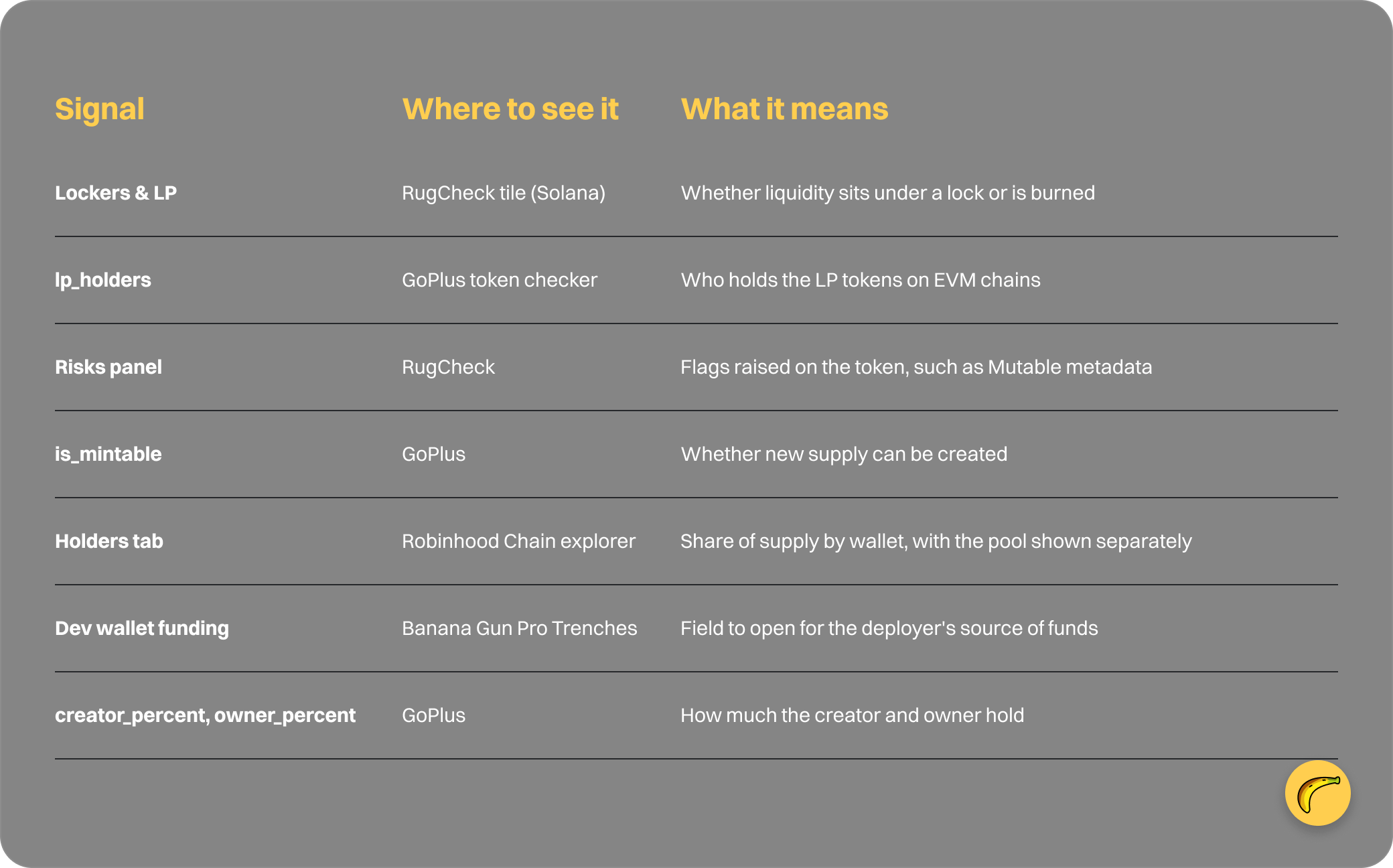
Where: on a Solana token, open it on RugCheck and read the Lockers & LP tile. On other chains, the GoPlus token checker returns lp_holders.
Bad result: liquidity that is neither locked nor burned. Whoever holds the LP tokens can withdraw the pool, and then there is nothing to sell into.
Example: on 1 October 2026 the RugCheck page for Bonk showed a RugCheck Score of 7 labelled Good, with 2.1M holders. Its Lockers & LP tile read $58K and 15%, and the Markets tile read $638K. RugCheck's token overview put LP Locked at 14.74%. That leaves about 85% that RugCheck does not count as locked, so open the tile and read the details before you treat the pool as covered.
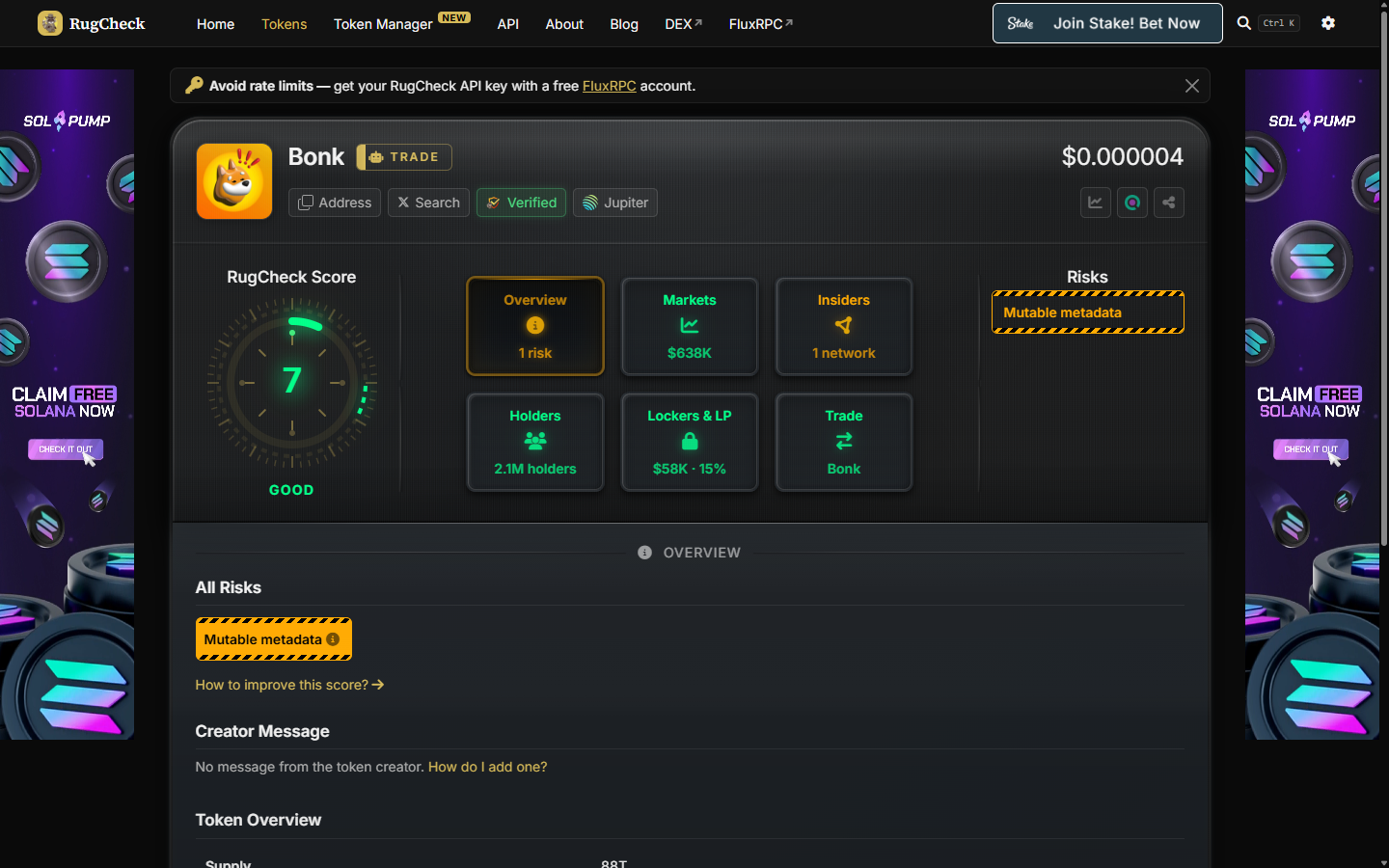
RugCheck page for Bonk showing the RugCheck Score, Risks, Holders and Lockers & LP tiles, 1 October 2026
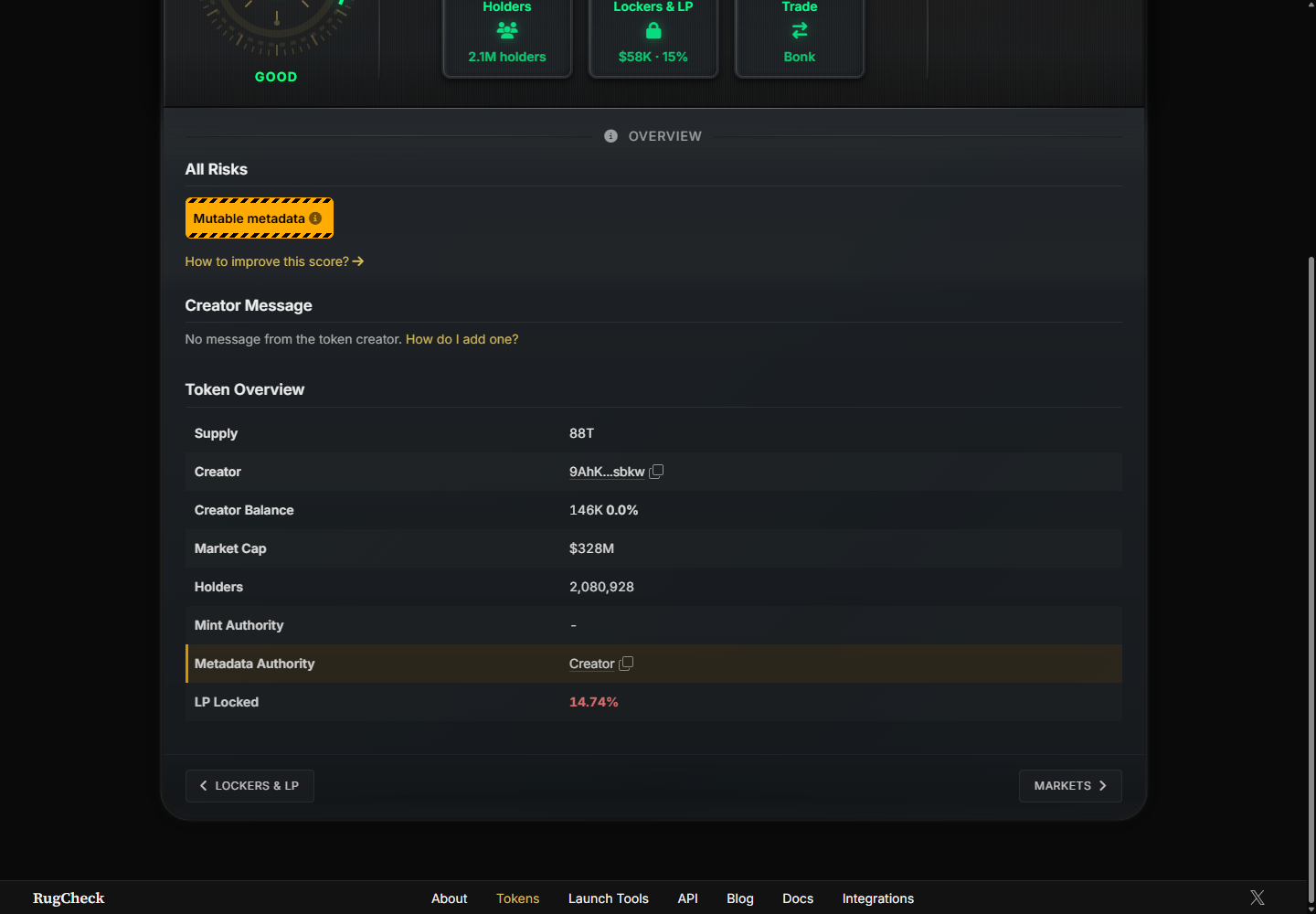
RugCheck Token Overview for Bonk on 1 October 2026: Mint Authority shows no value, LP Locked reads 14.74%
The Risks panel on that page lists a single item, Mutable metadata. The info icon next to it carries RugCheck's own explanation.
Check 3: Ask whether anyone can mint more supply
Look at: whether the owner or creator can create new tokens.
Where: on a Solana token, the Mint Authority row in RugCheck's Token Overview. For EVM tokens, the is_mintable field on the GoPlus token checker.
Bad result: mint power still in someone's hands. Extra supply dilutes every holder, and the person who mints it can sell into your buy.
Example: Bonk's Token Overview lists Mint Authority as "-", meaning none is set. A Solana token can also keep a freeze authority, which can lock holders' token accounts. RugCheck's Bonk overview showed no freeze authority row, so confirm that one in an explorer's token details. If either authority is still held, skip the token or size the buy as money you can lose. Our guide to reading a token contract explains both terms.
Check 4: Look at who holds the supply
Look at: the share of supply held by the top wallets, after you separate the liquidity pool from ordinary wallets.
Where: the Holders tab on the token page of the Robinhood Chain explorer. On a Solana token, the Holders tile on RugCheck shows the holder count.
Bad result: a handful of wallets holding most of the supply. A few wallets in that position can sell into every buyer.
Example: the Commander Vrax (VRAX) contract 0x257723230C9ccCF6A2Df1E7CF67CFFcFCF01EEb8 had a total supply of 1,000,000,000 and 320 holders on 1 October 2026. The top holder was UniswapV3Pool at 27.81%, which is the liquidity pool and not a whale. After it came wallets at 0.98%, 0.94%, 0.89% and 0.88%.
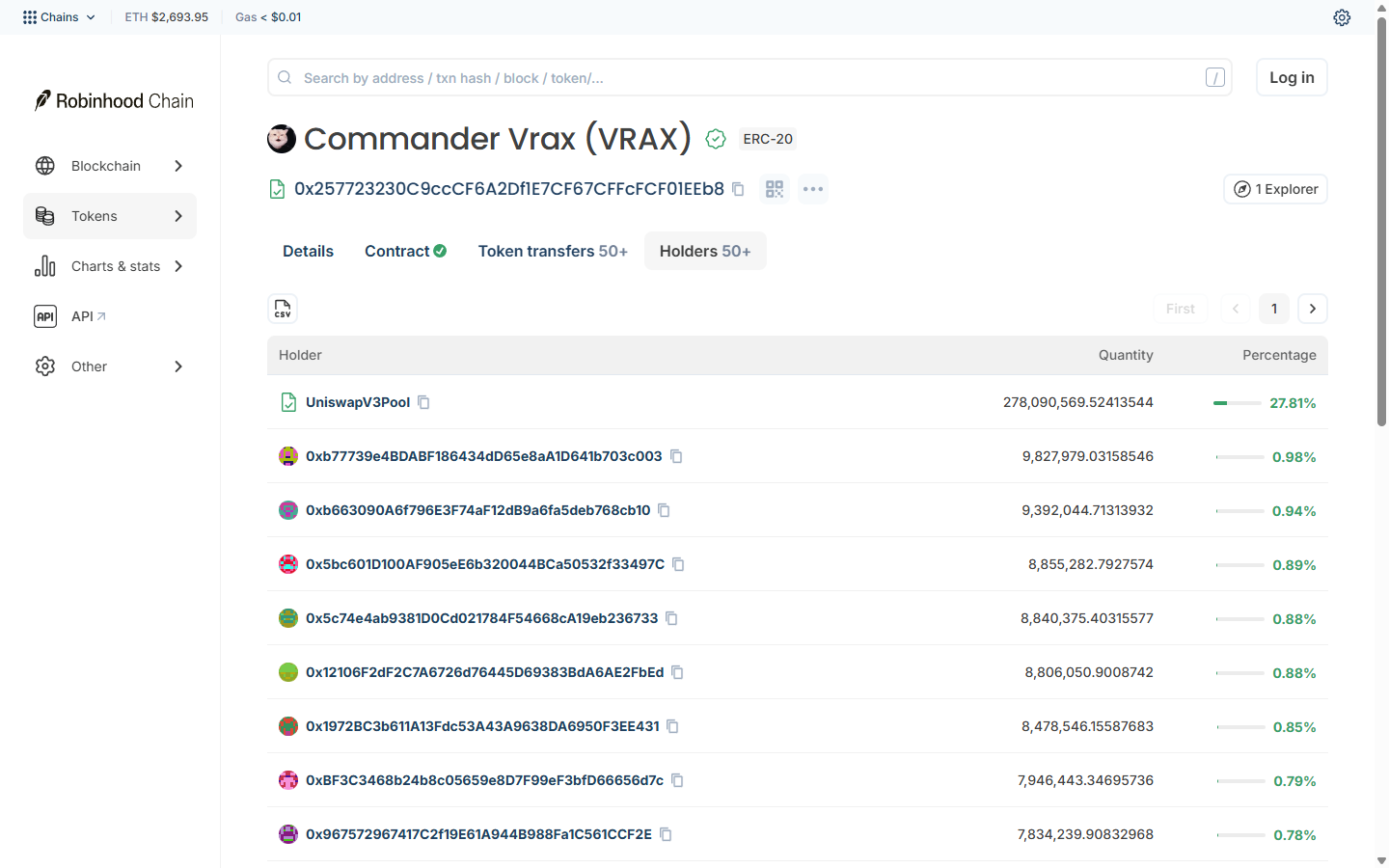
Holders tab for Commander Vrax on the Robinhood Chain explorer, with UniswapV3Pool at 27.81%, 1 October 2026
That spread looks flat, but a flat list cannot show one person splitting supply across many wallets. If one anonymous wallet held 40% next to the pool, the picture would change.
Check 5: Follow the deployer wallet
Look at: where the token's creator sits, how much of the supply it holds and what it has been doing.
Where: after you sign in, Banana Gun Pro's Trenches page lists NEW DEPLOYS with a "Dev wallet funding" field and "First 100 buyers status". For the wallet's history, open the deployer address on the explorer and read its activity. On EVM chains, GoPlus returns creator_percent and owner_percent.
Bad result: a creator wallet holding a large share, or one that has moved tokens toward the pool after launch.
Example: take the creator address from a new deploy and paste it into the explorer search bar. A wallet funded minutes before it deployed, then sending supply to many fresh wallets, is one to skip. The explorer shows what happened so far, not what the wallet does next.
What Banana Gun checks for you
Banana Gun documents Anti-Rug protection with an 80 to 85 percent success rate on the scenarios it targets. A pre-trade sell check also blocks tokens you cannot sell before the buy, and Anti-MEV is on by default.
Read that figure for what it is. By the same number, 15 to 20 percent of the targeted scenarios still get through, and it says nothing about a rug that works differently.
The sell check is a honeypot check, not a rug check: it runs before you buy, so it cannot stop a creator who pulls liquidity an hour later. You still pay the trade fee on a token that rugs, which is 1% on most chains and 0.5% on Ethereum manual buys. See how the defaults compare in our protections breakdown.
Signal reference
Frequently asked questions
What is a rug pull in crypto?
A rug pull is when a token's creators remove liquidity or sell a large hidden holding, leaving buyers unable to sell at any useful price. Liquidity that is neither locked nor burned is the usual route: whoever holds the LP tokens can withdraw the pool.
How do you check if a token is a rug pull?
Run five checks: confirm the contract matches the source, check the liquidity lock, check for mint power, read the holder distribution and follow the deployer wallet. No single tool covers all five.
Can a rug pull checker guarantee a token is not a rug?
No. Checkers read the token as it is now. A lock can expire, a deployer can sell later, and the page can look fine up to the minute it stops being fine.
Is a locked liquidity pool the same as a burned one?
No. Locked liquidity can come back to the lock holder when the lock ends, while burned LP tokens cannot be withdrawn. Check the lock details for how long it runs.
Does Banana Gun stop rug pulls?
Banana Gun documents Anti-Rug protection with an 80 to 85 percent success rate on the scenarios it targets. That is a rate, not a guarantee, and your own checks still matter.
Run these five checks on your next token, then paste the contract into Banana Gun when you are ready to buy.