
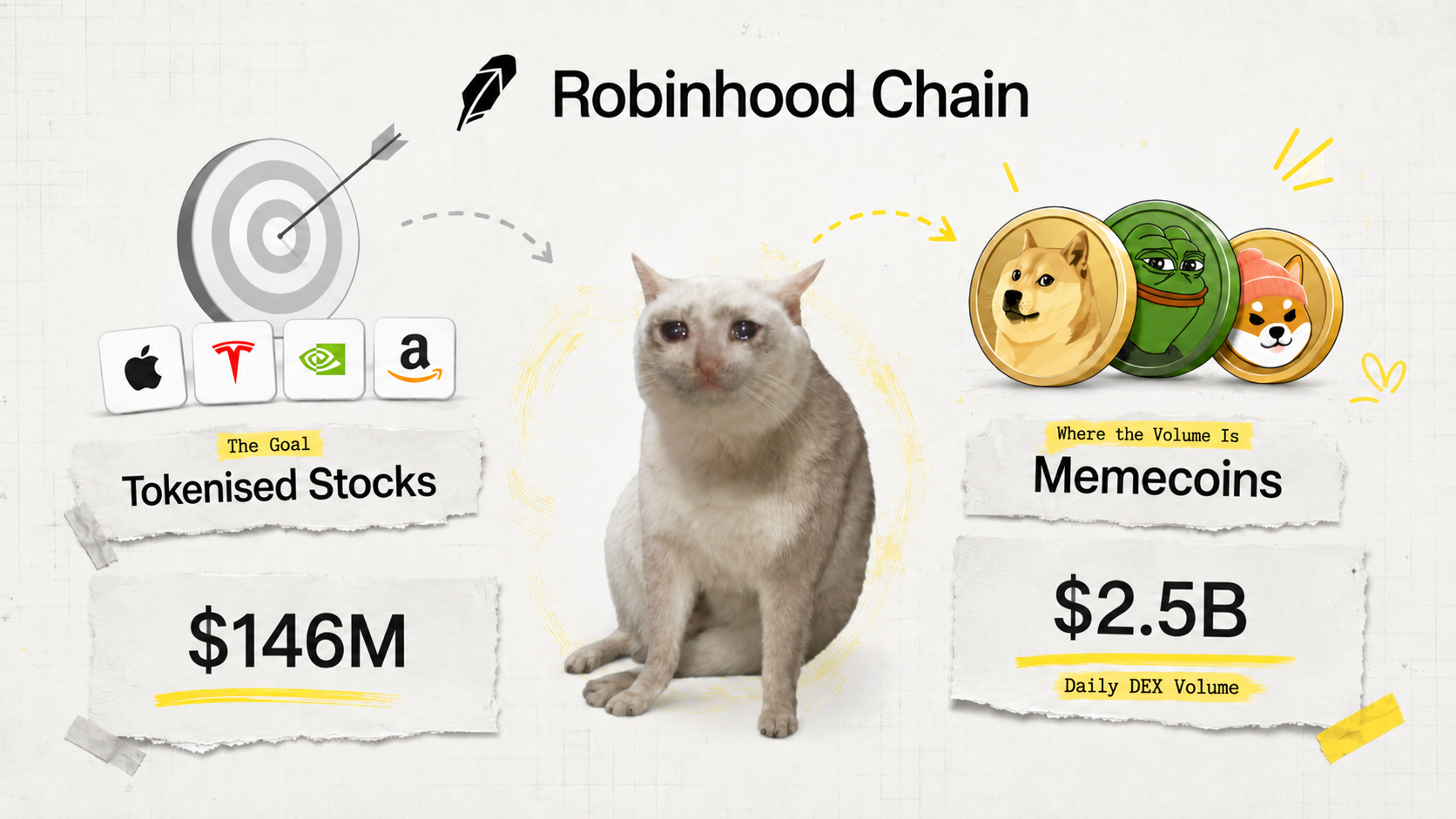
Robinhood Chain launched July 1, 2026, and within 90 days hit $2.5B in daily trading volume, $146M in tokenized stocks, and produced some of the most novel memecoin market structures in crypto history. Here's the full recap.
Built for RWAs, Used to trade Memecoins
Robinhood Chain went live on July 1, 2026, and unlike most blockchain launches, it didn't have to wait years for users to show up. The network arrived pre-loaded with 28 million existing Robinhood retail accounts.
The technical foundation is a Layer 2 built on Arbitrum technology, settling on Ethereum with fees paid in ETH. Day-one AMM coverage came from both Uniswap (deploying a dedicated pool infrastructure) and Pleiades (a proprietary AMM native to the chain).
The chain's core value proposition was clear from the jump: tokenized U.S. stocks as a DeFi primitive. Not stocks you hold in a brokerage account and forget about — stocks you trade, pair, and build products on top of. By September 18, 2026, the platform had accumulated $146 million in tradeable tokenized stocks, and per a Binance Research report covered by The Globe and Mail, Robinhood Chain and BNB Chain together handled 88.2% of all tokenized stock DEX trading in early September.
PONS, CASHCAT, and the Most Interesting Memecoin Structure of 2026
PONS was the launchpad protocol token, the infrastructure layer governing how new tokens got bootstrapped onto the chain. If you wanted exposure to the chain's token-factory activity, PONS was your instrument. It held the top market cap spot for a chunk of the summer before getting dethroned.
CASHCAT dethroned it. By mid-September, CASHCAT reclaimed the #1 spot by market cap on Robinhood Chain, riding a wave of momentum following the company's Q2 earnings call.
Then there's Artificial Inu ($AI). Launched mid-July via the LONG launchpad, its defining feature is the market structure underneath it. As discussed in this Reddit thread on r/RobinhoodChainHQ, $AI's primary liquidity pool is quoted against tokenized NVDA. Not USDC, not WETH. A Uniswap v4 pool backed by ~124 tokenized Nvidia shares sits at the heart of it, meaning $AI's price has a mechanical relationship with the compute trade.
By late September, $AI had reached a $57M market cap with $6.3M in 24-hour volume.
Community Reception: Sprinting Where Solana Jogged
By late September 2026, Robinhood Chain was processing $2.5 billion in daily trading volume — and on certain days, that number exceeded Ethereum's total daily volume. As one thread on r/RobinhoodChainHQ put it without much subtlety: "Robinhood did MORE THAN 2x total volume than Ethereum today."
The contrast with Solana's trajectory is instructive. Solana built its ecosystem the traditional way: validators first, RPCs and program libraries next, retail volume later, meme culture later still. It's a cumulative, compounding flywheel — and it works. Per a discussion on r/solana, Solana settled $14.7B of the $46B in tokenized asset volume onchain over the past year. Meaningful, but spread across a long runway.
Robinhood Chain didn't have a long runway. It had 28 million retail accounts and a product (tokenized stocks) with an immediately legible use case for mainstream users. The hybrid of serious tokenized-asset infrastructure with memecoin-native culture turned out to be exactly the right combination. Institutions and degens, sharing block space, neither group confused about why they're there. That's the emergent Robinhood Chain thesis, three months in, and it's a lot more coherent than most chains manage in three years.