

Arc, the Layer-1 blockchain built by Circle, charges gas fees in USDC instead of a separate network token. You do not hold, source, or top up a volatile coin just to move.
Every transaction cost and every token price on Arc sit in the same unit, which changes how you read your own cost basis.
What "Gas Paid in USDC" Actually Means
On most chains, gas and the asset you are trading are two different things. You hold ETH to pay for a Uniswap swap even if you are buying a token priced entirely in USDC.
Arc removes that split. Circle's own pressroom materials state it directly: "The ability to transact on Arc depends on the ability to obtain and use USDC to pay gas fees". If your wallet holds USDC, it holds gas.
How Arc's Gas Token Compares to Every Chain You Already Trade
If you trade across chains already, you are used to holding a native coin purely to pay for transactions. Arc is the outlier in that list, not the norm.
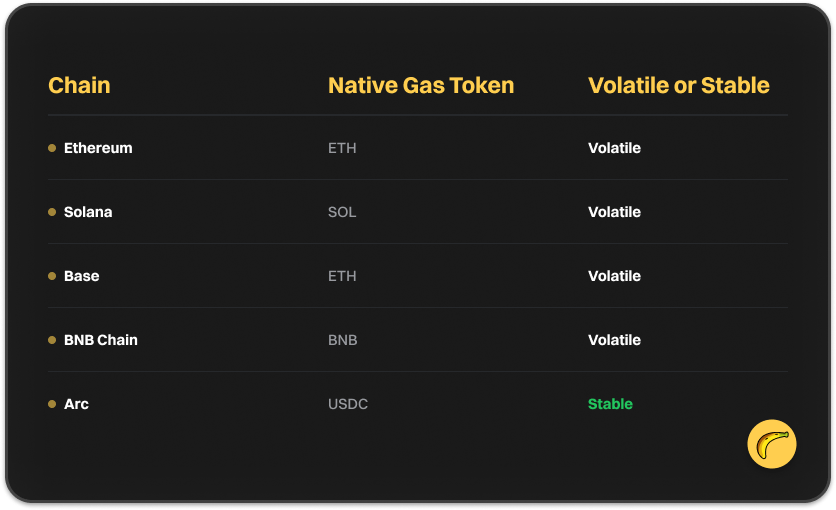
That matters most at the margins. Run out of ETH on a chain mid-session and you stop being able to transact until you acquire more, sometimes at a price spike you did not plan for. Run low on USDC on Arc and the fix is the same balance you were already managing for trading.
Think about what happens on a busy trading day. On Ethereum, a spike in network demand can push ETH gas costs up at the exact moment you need to move fast, and that spike sits on top of whatever the token itself is doing.
On Arc, a busy network still charges for block space, but the unit you are paying in does not add a second layer of price movement on top of the trade you are already managing.
What Changes For Your Cost Basis
Cost basis is the total you spent to get into a position, fees included. On a chain with a volatile gas token, that figure blends two different assets: the token you bought and the gas coin you burned getting there. On Arc, both legs are USDC. Your entry cost, your gas spend, and the stable side of your position all sit in one unit.
That does not make the math simpler in a trivial sense. It makes it legible in a specific one: you are not converting a volatile gas expense back into a stable reference currency just to know what a trade actually cost you.

Where Gas Fees Fit Into Buying and Bridging on Arc
Fee mechanics are the starting assumption behind two other decisions you will make on Arc.
Getting USDC onto the chain in the first place is its own question, covered in how to bridge USDC to Arc safely, since Circle's official crosschain tooling is developer-facing rather than a retail interface. Once you have USDC positioned, the actual trade sequence, from wallet login through setting an exit, is walked through step by step in how to buy tokens on Arc.
Circle's broader institutional push around USDC, including the market attention that followed Circle's public listing, is part of why a stablecoin-denominated gas model was the design choice for a chain built around institutional settlement in the first place.
Frequently Asked Questions About Arc Gas Fees
Do I need a separate token to pay gas on Arc?
No. Arc uses USDC as its native gas token, so the balance you use to trade is the same balance that pays transaction fees. You do not need to hold or source a second asset.
Does paying gas in USDC make transactions free?
No. USDC as the gas currency means fees are paid in a stable unit rather than a volatile one. It says nothing about whether a fee is charged or how it is calculated.
Can a stable gas fee protect me from a bad trade?
No. Gas currency and token quality are separate questions. A predictable fee unit does not screen liquidity, contract risk, or exit conditions on the token itself.
Is USDC used for gas on any other major chain?
Not among the chains most traders already use. Ethereum, Solana, Base, and BNB Chain all rely on a volatile native coin for gas. Arc pairs its gas token with its primary trading currency instead.