
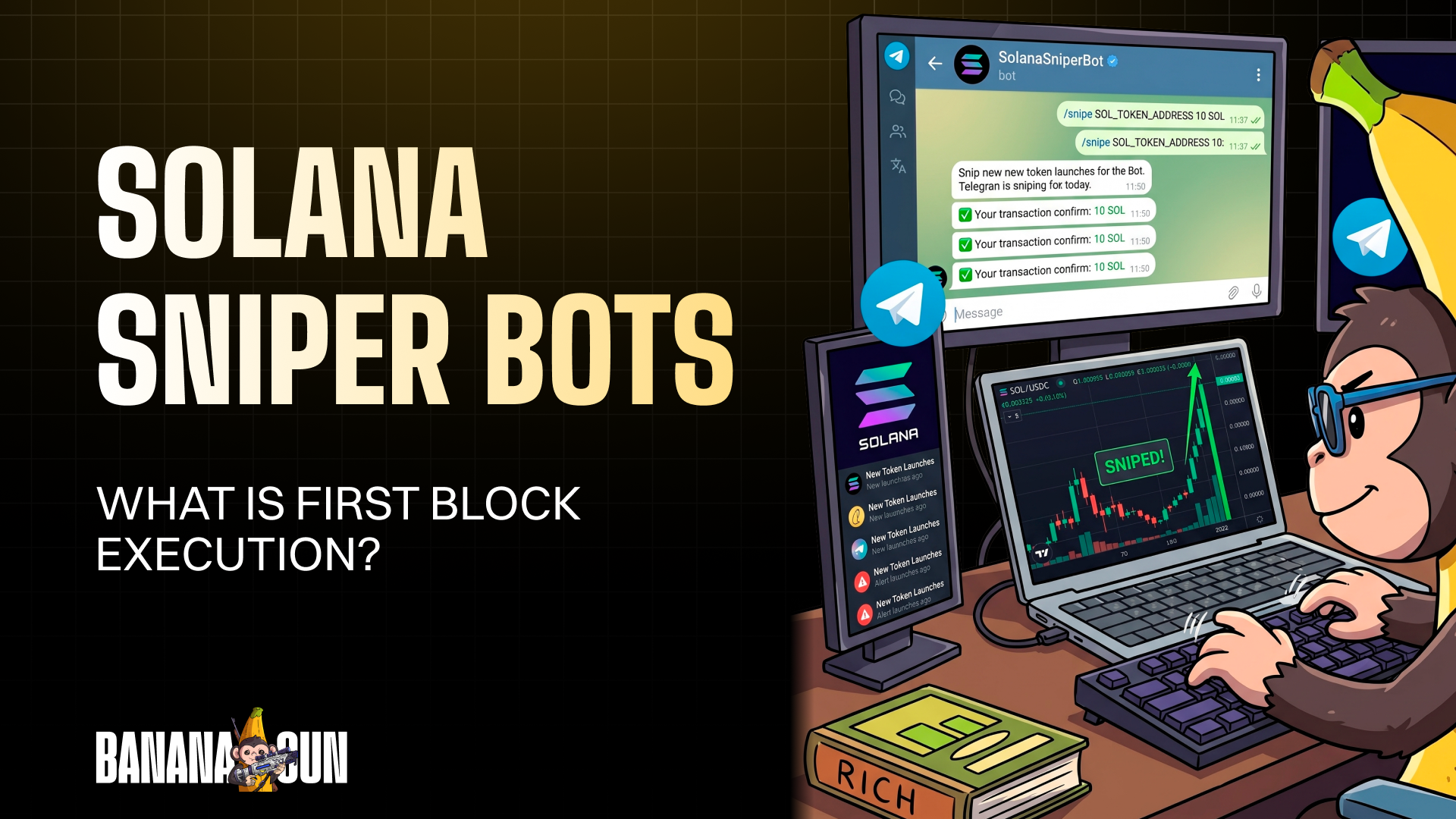
Every token launch on Solana has a moment before the price exists: the block where liquidity first appears on-chain. A solana sniper bot exists to be there at that exact moment, submitting a buy before anyone else can. Not a second after. Not two blocks later. That block, or nothing.
Most traders never see that price. By the time they paste a contract address into a DEX, the first hundred buyers have already accumulated and the chart has moved. This is not bad luck. It is a speed problem, and speed problems have infrastructure solutions.
This article explains how first-block execution works mechanically, what the different sniping modes do, why raw speed without security analysis is a fast way to lose money, and how to configure a snipe correctly using Banana Pro.
What Token Sniping Means on Solana
Tokens on Solana launch through platforms like Pump.fun, Moonshot, and LaunchLab. The launch mechanism differs slightly per platform, but the core event is always the same: at a specific block, liquidity gets added to a pool and the token becomes tradeable. That block is block zero for price discovery purposes.
Sniping means getting your buy transaction into that block, or as close to it as the infrastructure allows. Anyone buying in block zero pays the launch price. Anyone buying in block two or three is already buying into price movement caused by block-zero buyers. The difference between these positions on a token that moves 10x is obvious.
Manual DEX trading cannot compete here. The time it takes you to notice the launch, copy the contract, switch tabs, set slippage, and confirm the transaction is measured in seconds. A solana sniper bot operating on Jito infrastructure measures its response in milliseconds. You are not competing with other human traders. You are competing with other bots, and the only variable that matters is execution infrastructure.
Pump.fun has a secondary sniping opportunity worth understanding. Before a token migrates from the bonding curve to Raydium, which happens when the bonding curve fills to approximately 85%, you can snipe the pre-migration position. This is an earlier entry than what most traders see as the launch and carries its own risk profile, since the token has not yet reached open-market liquidity.
How First-Block Execution Works
There is no single sniper mode. Banana Pro runs three distinct execution modes depending on the launch type and your requirements.
First Bundle or Fail (FoF) is the most aggressive. It targets block zero as the first bundle submitted to Jito’s block engine. Your transaction is packaged and routed with the goal of landing in the opening block. FoF requires a minimum of 10 active wallets to function. The name describes the logic exactly: if the bot cannot land in the first bundle, it does not execute at all. There is no fallback at a worse price.
FoF Backup activates automatically on two specific launch types: MEV-protected launches and Deadblock launches. Some token deployers use mechanics designed to make standard FoF submissions fail. FoF Backup adjusts the bundle strategy to handle these edge cases without requiring any manual configuration on your end. It operates as a secondary layer that maintains first-block targeting even when the standard bundle route is blocked.
Auto-Sniping is the mode for traders who want continuous coverage across all new token activity without configuring individual snipes. It monitors for liquidity detection events across the supported launchpads and submits automated buys when a qualifying pool appears. You set the parameters once and the bot runs from there.
On Ethereum, Banana Gun achieves an 88% first-block success rate using this bundle infrastructure. On Solana, Jito’s block engine provides the same underlying mechanism, giving you optimized block inclusion on a chain where block times run at roughly 400 milliseconds. For context on how MEV protection fits into the execution stack, the MEV protection explained article covers the mechanics in detail.
Speed Without Safety Is How People Lose Money
Getting into block zero on a malicious token is strictly worse than missing the trade entirely. You bought at the best possible price on a token designed to drain your wallet. The math does not improve based on your entry timing.
This is where pre-flight simulation changes the risk profile. Banana Simulator runs every transaction against live chain state before any funds are committed. It checks for honeypot mechanics, which are contracts that allow buys but block sells; hidden minting functions that can dilute your position post-entry; and malicious contract logic that activates after the launch window closes. If the simulation detects that a sell transaction would fail, the trade is blocked automatically. You never see a failed trade. The system stops it before execution.
After entry, Anti-Rug Technology continues monitoring the contract in real time. It watches for sudden liquidity withdrawals, tax structure modifications (a common pattern where fees get raised to 99% after the initial launch buyers are in), and developer blacklisting of holder addresses. On MEV blocks, Anti-Rug Technology achieves an 80-85% success rate at fronting the rug transaction, meaning your exit processes before the rug completes. A Transfer on Blacklist feature handles the edge case where a developer blacklists your wallet: the system redirects your tokens to a secondary address before the blacklist activates.
No security system catches every bad actor. The Solana launchpad space includes sophisticated contract manipulation that can evade any pre-flight check. But using a solana sniper bot without pre-flight simulation is choosing to skip the seatbelt because the car goes fast. The speed is real. So is the crash exposure.
What to Look for Before Sniping a Token
Most new tokens are not worth sniping. The filtering work happens before you commit capital, and the relevant metrics are consistent across launchpads.
Bonding curve percentage shows how far along the token is toward Raydium migration. A token at 4% of its curve needs sustained buying pressure over time to produce a meaningful move. A token at 72% is approaching migration, which creates momentum but also means early concentrated holders are positioned to sell into that momentum.
Developer, sniper, and bundler wallet concentration is the most important signal. If three wallets labeled as bundlers hold 35% of supply at launch, the token was pre-coordinated. That is not automatically disqualifying, but those wallets have a planned exit and more information than you about when to use it.
Liquidity depth determines whether your exit is executable at any reasonable size. Entering a significant position into a pool with minimal liquidity means the price impact on exit wipes out any gain before you factor in token performance.
Social presence is a soft filter. Tokens with no verifiable community activity before launch survive past the first 30 minutes at a much lower rate than tokens with any real prior interest. This does not replace proper due diligence, but it separates noise from signal quickly.
The Trenches feed in Banana Pro surfaces all of this in real time. Tokens are color-coded by status: red for newly launched, yellow for approaching migration, green for migrated. Per token you see age, holder count, developer and sniper and bundler wallet concentration, liquidity, volume, transaction count, and social links. The feed pauses on hover and filters by bonding curve percentage, supply distribution, liquidity range, volume, market cap, and age. You get the full pre-snipe context in one view without opening a separate analytics tool.
For a detailed breakdown of how to read token signals on Pump.fun specifically, the complete Pump.fun guide covers launch mechanics, bundling patterns, and migration timing in detail.
Setting Up a Snipe in Banana Pro
The SNIPE widget in Banana Pro is focused. You configure a small number of parameters and the system handles execution.
Amount is how much SOL you commit per snipe. Set this at a size where a total loss is acceptable, because for any individual snipe that outcome is possible and you should price it in before entering.
Min/Max SOL Liquidity defines the liquidity range that triggers the snipe. A minimum prevents execution on pools too thin to exit meaningfully. A maximum filters out tokens that launched with suspicious pre-seeded liquidity, which often signals insider positioning ahead of retail.
Min/Max Token Liquidity sets the token-side liquidity bounds, working alongside the SOL liquidity range to define the exact pool condition you are targeting. Combining both filters means you only execute on launches that meet your full specification.
Duration controls how long the snipe order remains active. If no qualifying launch appears within the window, the order expires without execution. This prevents stale orders from filling on launches you are no longer watching.
MEV Protection should stay on. Unprotected transactions on Solana are visible in the public mempool and can be sandwiched. Jito-routed transactions bypass the public mempool entirely, removing that attack surface from the equation.
Slippage is the maximum price movement you will accept between order submission and fill. On fast-moving launches, this needs to be wide enough to execute but calibrated carefully: too wide and you fill at a price that negates the first-block advantage.
The Quick Buy popup provides one-click execution for tokens you have already identified through The Trenches. Instead of navigating to a full trade view, an execution panel appears directly over the feed. Multi-wallet support lets you distribute a snipe across multiple wallets simultaneously, reducing concentration risk and improving your aggregate fill on a single launch event.
If you are ready to set this up, Banana Pro runs in a browser at pro.bananagun.io. No MetaMask required. Login is through Google, Twitter, or Telegram via Privy, and your private keys are generated locally and never leave your device.
Frequently Asked Questions
What is a sniper bot in crypto?
A sniper bot crypto traders use is an automated program that monitors the blockchain for new token liquidity events and submits a buy transaction the moment liquidity is detected, ideally in the same block the pool opens. The goal is to buy before price discovery pushes the token above the launch price. On Solana, sniper bots use Jito infrastructure and bundle submission to maximize the chance of landing in block zero.
Is token sniping legal?
Token sniping is legal. It is not front-running in the traditional sense because the sniper is not reading another user’s pending transaction and inserting ahead of it. A solana sniper bot responds to an on-chain event, liquidity being added, and competes to be included in the same block. This is a permissionless activity on public blockchains. The risk is market risk: the token you snipe may be a scam, a honeypot, or a rug executed immediately after launch.
What is first-block execution in token sniping?
First-block execution means your buy transaction is included in block zero, the very first block after a token’s liquidity pool goes live. At that point, no price discovery has occurred and no other buyers have executed. First-block buyers get the closest approximation to the launch price available on-chain. On Ethereum, Banana Gun achieves an 88% first-block success rate using bundle submission. On Solana, Jito-based bundle routing is used to optimize block inclusion across all supported launchpads.